Menopause Changed More Than My Body
It changed how I wanted to live, work, travel, and spend the next chapter of my life.

Why You Wake Up at 4 AM in Menopause (And the 3-Thing Routine That Actually Helped)
Somewhere around forty-eight, my body started hosting a 4 AM meeting no one attends.
No agenda. No minutes. Just me, wide awake, staring at the ceiling while the house is silent and the dog is aggressively unconcerned about my situation.
If you're reading this, you know the meeting. You've been in the meeting. You've possibly given a presentation at 4:07 AM about a decision you made in 2003.
Here's the part that took me a year to figure out: it isn't anxiety. It isn't your marriage. It isn't the email you sent Tuesday.
It's cortisol, doing exactly what it evolved to do — at exactly the wrong moment for a menopausal body.

What's actually happening at 4 AM
Cortisol is your body's built-in alarm system. It's supposed to rise slowly through the second half of the night so you wake up alert around 6 or 7 AM. That's called the cortisol awakening response, and it's a beautiful, evolutionarily-tuned system.
For people who are not, at the moment, running out of estrogen.
Estrogen and progesterone are what buffer cortisol overnight. They keep the curve smooth. When those hormones drop off — during perimenopause and menopause — the buffer disappears. Cortisol still rises. It just does it earlier, faster, and without anything to keep it from spiking.
You wake up at 4 AM feeling wired. Sometimes you feel dread. Sometimes you feel a hot flash starting. Sometimes it's all three at once, which is, frankly, rude.
The problem isn't that something is wrong with you. The problem is that your body's morning-alarm system no longer has its overnight bodyguards.
Why the standard sleep advice doesn't work
Wind down two hours before bed. No screens after 8 PM. Practice good sleep hygiene.
None of it is wrong. It's just written for people whose hormones aren't actively sabotaging them.
You can do everything the sleep books tell you to do and still wake up at 4 AM, because the problem isn't your evening routine. The problem is your cortisol curve is set to launch too early, and your morning light signal is too weak to walk it back.
What actually helps is a routine built around that reality. Three things. That's it.
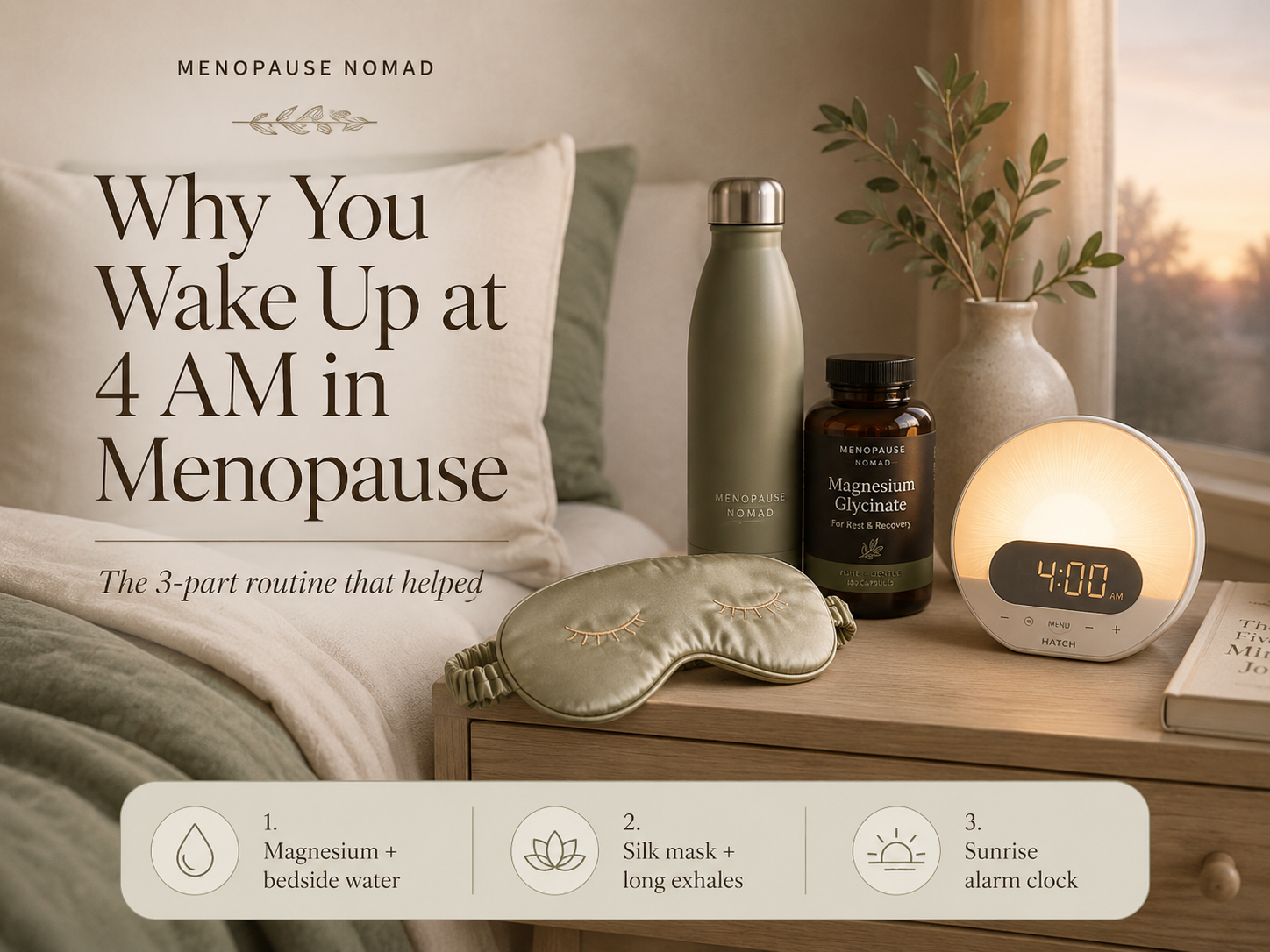
The 3-thing routine
1. The 9 PM anchor: magnesium glycinate + water on the nightstand
The single biggest change was magnesium glycinate, taken about an hour before bed.
Not magnesium citrate — that one moves your bowels, which is not the goal here. Glycinate is the form that calms the nervous system without any digestive drama.
I keep my magnesium glycinate on the bedside table next to an insulated water bottle. Standing up in the middle of the night to fumble in a cupboard is how you go from "briefly awake" to "up for the day."
The bedside water bottle sounds obvious. It isn't. Dehydration is one of the things that triggers the 4 AM cortisol spike. Sipping water the moment you wake — before you check your phone, before the spiral starts — takes about ninety seconds and often ends the wake-up entirely.
Total setup cost: around $30. Time invested: none. This was the biggest sleep change I made in menopause.
2. The 4 AM protocol: silk mask and long exhales
If you wake up at 4 AM, do not fight it. Fighting it triggers more cortisol, which pins you awake for another ninety minutes.
The protocol:
Sip water
Do not look at the phone
Do not check the time
Put on a silk sleep mask
Slow, long exhales — longer exhales than inhales, for about a minute
The mask is the piece I resisted longest, and it's the one that matters most. Not because silk is fancy. Because when you wake at 4 AM in July, your body is trying to figure out whether it's morning yet. If any light is leaking through — a streetlight, an appliance LED, dawn creeping around a blackout curtain that isn't quite blackout — your body reads "morning" and shuts off melatonin.
The mask keeps that signal off until it's actually morning.
Long exhales activate the vagus nerve, which lowers cortisol. Not a lot. Enough.
Most nights, this puts me back to sleep within twenty minutes. Some nights it doesn't. On those nights, I get up, drink water, sit in a low-lit room, and read a boring book on paper. No screens, no news, no problem-solving.
3. The morning light reset: sunrise alarm clock
This is the one nobody warns you about, and it's the one that changed my sleep in about three weeks.
Your cortisol curve is anchored by morning light — specifically, bright light in your eyes within the first hour of waking. If that signal is missing or delayed, your body loses the anchor for when "morning" is. And the curve drifts earlier. And earlier. Until you're waking at 4 AM.
The fix is a sunrise alarm clock. It's a lamp that gradually brightens over 30 minutes before your alarm time, so your body starts registering "morning" while you're still asleep. Over a few weeks, the cortisol curve shifts back to where it belongs.
I ignored this recommendation for two years because it sounded like wellness-influencer nonsense.
I was wrong.
The sunrise alarm walked my wake-up time from 4:15 AM back to 6:00 AM over about three weeks. If you live somewhere with a real winter — I'm in Alberta, so I'm being conservative — pair it with a 10,000-lux light therapy lamp for morning use. The sunrise clock handles the wake-up. The therapy lamp gives you daytime light your body would normally get from being outside, which in January, you are not.
What didn't work
To be honest about what didn't move the needle:
Melatonin. Small doses (0.3 mg) helped a little. Bigger doses made the wake-up worse. Most drugstore doses are wildly too high.
Sleep trackers. Useful for a month, then anxiety-inducing. I stopped after my ring told me I slept 6 hours and my face told me I slept 4. My face was right.
Herbal sleep teas. Fine. Ritual value. Not curative.
Weighted blankets. Helped my before-bed anxiety. Did not stop the 4 AM wake-up. The cooling versions are worth it if you run hot.
CBD. Mixed results. Personal call.
The bottom line
If you're waking up at 4 AM in menopause, you are not broken and you are not doing anything wrong. Your buffering hormones dropped. Your cortisol curve moved earlier. Your morning light signal is probably weaker than it should be.
The three-part routine that helped me:
Magnesium glycinate + bedside water at 9 PM
Silk mask + long exhales when the wake-up happens
Sunrise alarm clock to slowly walk the cortisol curve back where it belongs
It's not glamorous. It's not a wellness protocol. It's the smallest number of things I could add to my life without pretending to become a different person.
If this is happening every night and it's been going on for months, talk to your doctor about hormone therapy. HRT is not the villain the 2002 headlines made it out to be, and for a lot of women it makes the 4 AM meeting stop calling itself into session.
FAQ
Is waking up at 4 AM normal in menopause? Yes. It's one of the most common perimenopause and menopause complaints, driven by the loss of estrogen and progesterone's buffering effect on the overnight cortisol curve.
Should I take melatonin for menopause insomnia? Low doses (0.3 mg) can help some people. High doses often make early wake-ups worse. Most drugstore melatonin (3 mg, 5 mg, 10 mg) is far more than the body actually uses.
How long does menopause insomnia last? It varies. Perimenopausal sleep disruption can go on for years. The good news: the routines that address the underlying hormonal shifts — light exposure, magnesium, and where relevant, HRT — usually help within weeks, not years.
Does HRT help with the 4 AM wake-up? For many women, yes, particularly if progesterone is included. Progesterone in particular has a direct calming effect on the nervous system overnight. Talk to a doctor who actually specializes in menopause — not all doctors are up to date on current HRT research.
Nothing in this post is medical advice. It's the story of what worked for me. Your doctor knows your body; I do not.
This post contains affiliate links. If you buy through them, I earn a small commission at no cost to you. I only recommend things I actually use.

Subscribe to our Mailing List
And that's just a peek at what we offer. Get more marketing tips straight to your inbox.
Who's writing this:
I'm not a menopause expert, a travel expert, or an expat-life guru. I'm a 51-year-old woman who spent her career in corporate, lost her dad recently, is dealing with HRT that may or may not be working, and decided the next chapter is going to be lived somewhere with better light and slower mornings. I'm documenting all of it on Instagram and Pinterest as @menopausenomad. The checklist is one piece. The journey is the rest.
The Honest Carry-On Checklist for Menopausal Women
23 items I actually pack. 7 I stopped bringing. Written by a 51-year-old who travels carry-on only and is figuring out menopause in real time.
What's In The Checklist?
The 23 items I won't fly without (with brand-agnostic notes)
The 7 things I packed for years and finally stopped bringing
What goes in the personal item vs. the carry-on (the menopause edit)
The cooling/sleep kit that lives at the top of the bag for a reason
A printable one-page version for the women who like a paper checklist (it's most of you)
Why I Started Menopause Nomad
If you've ever stood in front of a hotel mirror at 3 a.m. wondering why no one warned you about this part of menopause — this is for you.


I’m 51. After nearly three decades in corporate leadership, I found myself asking a bigger question:
Where do I actually want to spend the next chapter of my life?
Right now, that answer may be Cyprus. Or Crete. I haven’t decided yet.
What I do know is this: menopause changed far more than my body. It changed how I want to live, work, travel, and move through the world.
I’m building toward a slower, more intentional life abroad while navigating hot flashes that ignore itineraries, sleep that now requires strategy, and a body that suddenly negotiates every carry-on item.
I’ve always traveled carry-on only.
Menopause renegotiated the contents.
The checklist I created isn’t influencer packing fantasy or affiliate-stuffed perfection. It’s the real list — what actually helps, what didn’t work, and what I stopped bringing entirely.
If you’re somewhere between “I wonder if I could do this” and “I’m actually doing this,” I made this for you.
Testimonials
What others are saying

"Excellent service!"
Excellent service! They take care of everything from cleaning to maintenance, making managing my vacation rental completely stress-free. Highly recommend!


"Highly recommend this"
"Testimonial lorem ipsum dolor sit amet, consectetur adipisicing elit. Autem dolore, alias, numquam enim dolor elit." - Your Name
" Impressed with their professionalism"
I’ve been so impressed with their professionalism and attention to detail. The in-house cleaning and maintenance teams are outstanding, and I’ve seen a noticeable difference in guest satisfaction.
"Hassle free process"
They handle everything seamlessly! I no longer worry about the upkeep of my rental, and their prompt communication has made the entire process hassle-free.
Testimonials

John Doe
Lorem ipsum dolor sit amet, consectetur adipiscing elit, sed do eiusmod tempor incididunt ut labore et dolore magna aliqua. Ut enim ad minim veniam, quis nostrud exercitation ullamco laboris nisi ut aliquip ex ea commodo consequat.


Jane Doe
Lorem ipsum dolor sit amet, consectetur adipiscing elit, sed do eiusmod tempor incididunt ut labore et dolore magna aliqua. Ut enim ad minim veniam, quis nostrud exercitation ullamco laboris nisi ut aliquip ex ea commodo consequat.
Get In Touch With Us
Phone:
(780) 882-9763
Shop:
Site 4 Comp 3 RR 3, Rimbey AB T0C 2J0
Email:

Email: [email protected]
Site: www.menopausenomad.com