Menopause Changed More Than My Body
It changed how I wanted to live, work, travel, and spend the next chapter of my life.
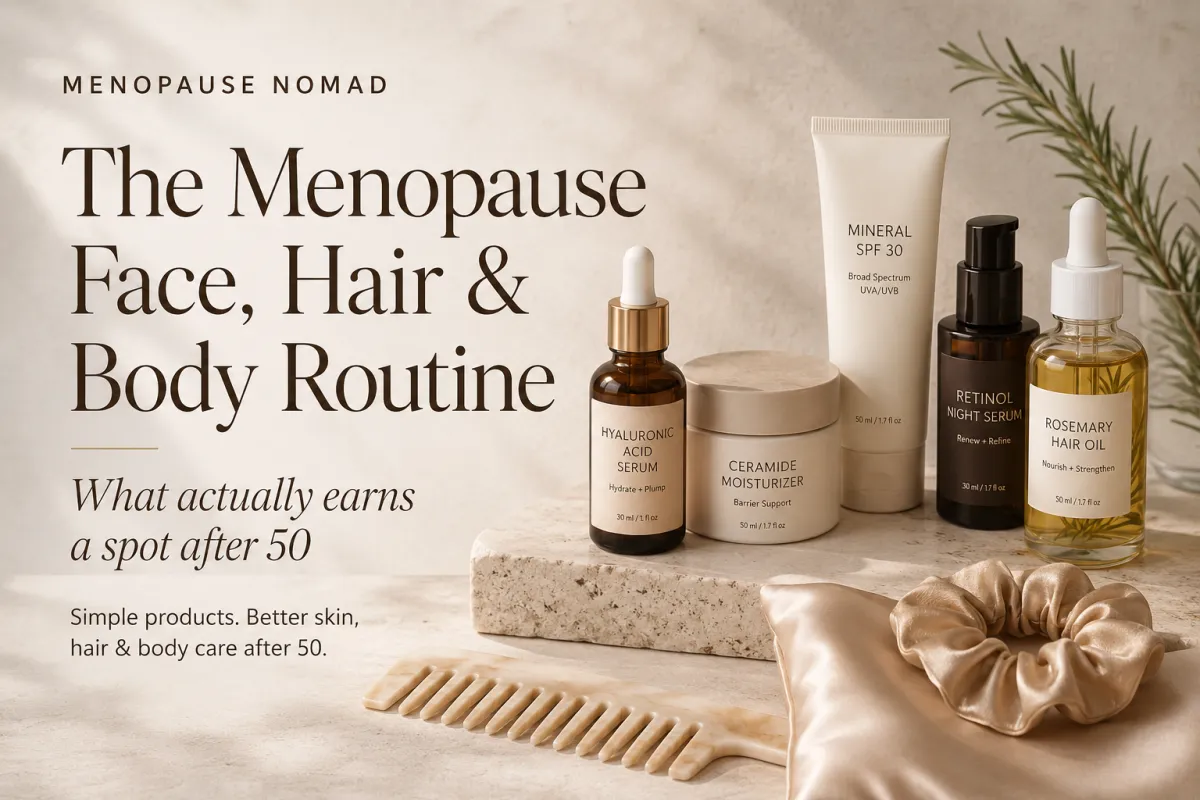
The Menopause Morning Mirror: A Face, Hair, and Body Routine That Actually Works
At 49, my face changed overnight. It took me two more years to update the routine, mostly because I kept trying to force the old routine to work harder.
It didn't. Menopausal skin does not respond to being yelled at.
The mirror at 50 is presenting information the routine was not written for. The cheekbones are lower. The under-eye is drier. The forehead is thinner. Hair on the head is thinner too, which is somehow accompanied by hair on the chin that is absolutely not. Body cream sits on the skin like frosting. The face, formerly a functioning organ, has become a question.
Here is the head-to-toes morning routine that actually works — face, hair, body, and the silk pillowcase discourse. Some pieces are cheap. Some are ugly (looking at you, urea cream). All of them earn their spot.
Why menopause changes everything above the neck
Three shifts drive most of it.
Collagen drops fast. Skin loses about 30% of its collagen in the first five years after menopause. That's the "why did my face fall a little" reality. The routine cannot bring it back, but it can slow the next round.
The skin barrier weakens. Ceramide and lipid production drop. That's why products that used to feel great now feel like they're sitting on top of your skin, and why formerly reliable moisturizers now do nothing.
Cell turnover slows. The 28-day cycle stretches to 40-plus. Dead skin builds up. Everything looks slightly duller than it did a year ago and you can't put your finger on why.
The routine below is designed for those three facts. Nothing on the list is a miracle. Everything on the list is a small correction that adds up.
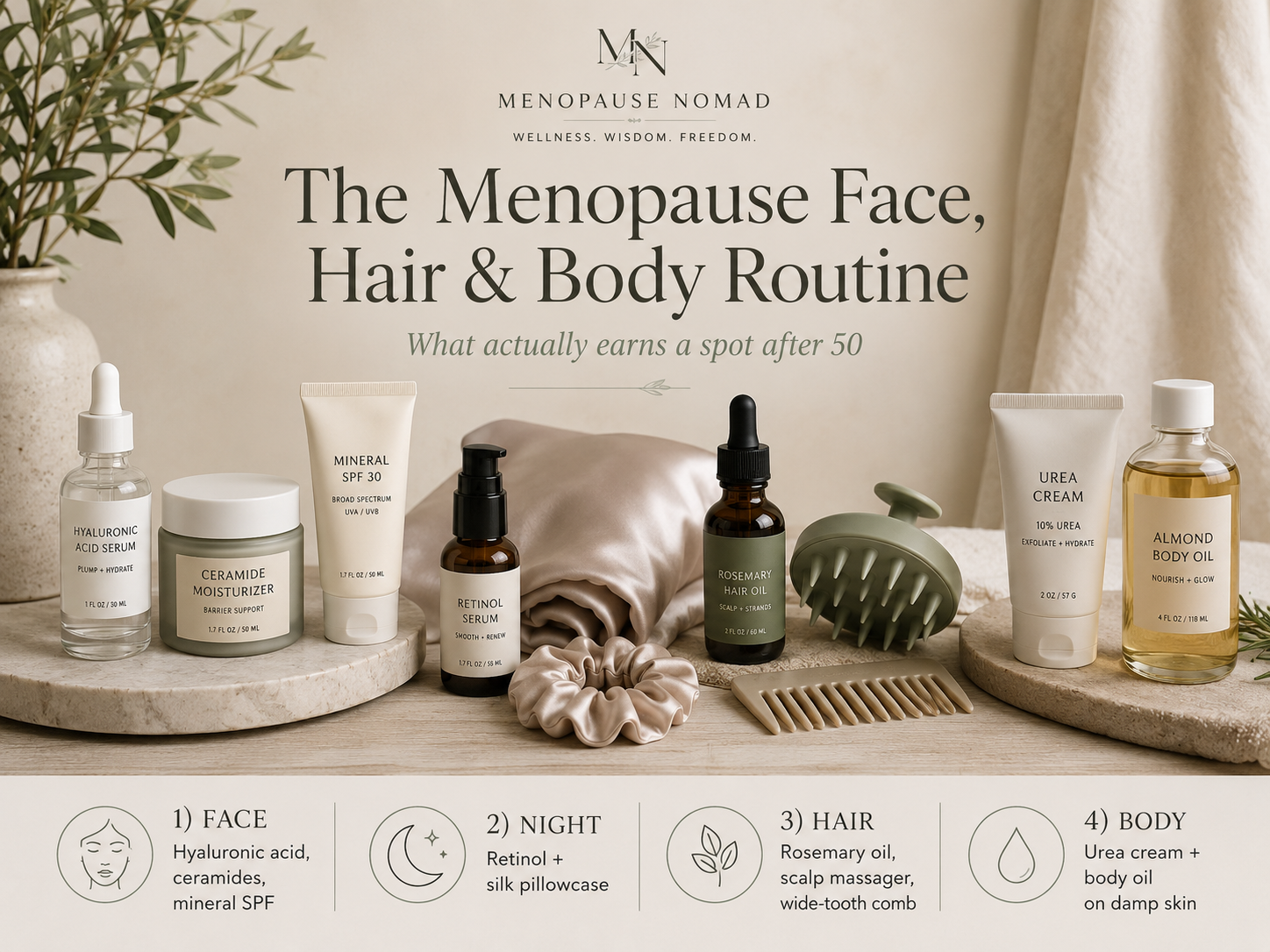
Part 1: The 5-step morning face routine
Simple. Not fancy. Every step earns its spot.
Step 1: Gentle cleanse — or just water.
Menopausal skin does not need a morning cleanser most days. Splashing warm water on your face and patting dry is often enough. If you need something, use a cream cleanser, not a foaming one. Foam strips a barrier that is already thin.
Step 2: Hyaluronic acid on damp skin.
Hyaluronic acid serum applied to damp skin pulls water into the top layers. Applied to dry skin, it pulls water out. This is the single most common skincare mistake in menopause — the HA is fine; the timing is wrong.
Damp face. Two drops. Press in. Move on.
Step 3: Ceramide moisturizer.
Ceramides are the fatty molecules that hold the skin barrier together. Menopausal skin doesn't make enough of them anymore, so you have to apply them.
A ceramide moisturizer — CeraVe's is the cheapest reliable one, but any brand with ceramides high in the ingredient list works — is doing more for menopausal skin than most $80 creams. This is one of the few times "generic drugstore" beats "luxury."
Step 4: Mineral SPF 50.
Non-negotiable. Explained below.
Step 5: Retinol — but at night, not morning.
A gentle retinol (0.3% to start; work up to 0.5%) is one of two ingredients with actual evidence for menopausal skin. It goes on at night, after moisturizer, three nights a week to start. Not in the morning. Retinol degrades in sunlight and makes skin more sun-sensitive.
Total morning time: about 3 minutes. Total morning ingredients: four.
The mistake at 50 is not that people don't have enough steps. It's that they have too many.
Part 2: Why SPF at 5 AM in November is not a joke
Sun damage doesn't check the calendar. UVA — the aging wavelength — penetrates clouds, windows, and low winter light. It's out in Alberta in December at 8 AM. It's out at 4:30 PM. It's out during your commute.
Menopausal skin has less natural protection than pre-menopausal skin. Collagen is thinner. Melanocytes are more reactive. Melasma — the hormonal pigment patches — is triggered by tiny amounts of light, including indoor light from a bright window.
Mineral SPF 50 — zinc oxide, not chemical filters — is the one to use in menopause. Chemical SPFs can trigger heat and can worsen melasma; minerals sit on the skin and reflect. Look for zinc oxide 10% or higher.
Two products worth having in your bag for reapplication (which, yes, matters):
An SPF stick for touch-ups over makeup
An SPF lip balm — lips lose pigment protection in menopause and burn embarrassingly fast
If you cannot bring yourself to do a full SPF step, a tinted mineral SPF doubles as light coverage and eliminates the "another step" argument.
Alberta in November? Yes. SPF. Every morning. This is the single highest-return investment in the whole routine.
Part 3: The silk pillowcase — a menopausal verdict
I resisted the silk pillowcase for two years. It was too much of an influencer thing. Then I bought one, and here is the honest verdict after 60 days.
What it does:
Reduces friction on hair overnight, which meaningfully reduces breakage. This one is real. My hair looks better in the morning.
Reduces the sleep lines that no longer bounce back the way they used to. Not eliminates. Reduces.
Keeps cooler than cotton. Modest but real.
Doesn't absorb your skincare into the pillow, which cotton does.
What it doesn't do:
Stop hot flashes. Nothing does.
Reverse hair thinning. If your hair is thinning, the pillowcase helps the strands you have but does nothing for the follicles.
Justify the $150 versions. A 22-momme mulberry silk pillowcase around $30–50 does everything a $150 one does.
The verdict: worth it, but as a hair and skin supporter, not a hair and skin solution. Buy the reasonable one.
Add silk scrunchies for the same reason — they don't dent hair the way elastic does, and menopausal hair breaks where dents happen.
Part 4: Hair thinning is real. Two products moved the needle.
Menopausal hair thinning is not vanity. It's follicle miniaturization driven by estrogen loss and, for some women, an increase in the effect of androgens on the scalp.
Before spending money on products: get bloodwork. Thyroid, iron, ferritin, vitamin D. Thinning hair in menopausal women is often iron or thyroid, not menopause. Fix the underlying cause first. No topical product outperforms iron supplementation if you're actually low.
That said — for me, with normal bloodwork, two products actually moved the needle over 12 weeks:
Rosemary essential oil, diluted, massaged into the scalp 3 times a week. A 2015 study found rosemary oil comparable to minoxidil at six months for androgenic hair loss. It smells like a roast dinner, but it works. Dilute it in carrier oil (jojoba or almond) and massage in with your fingers or a brush.
A scalp massager brush in the shower. Cheap ($10), silicone bristles, used with shampoo. Increases blood flow to follicles. Feels good. Actually helps.
Also worth having:
A wide-tooth wet comb — brushing wet hair with a regular brush is where menopausal hair breaks. Wide-tooth combs, wet, no exceptions.
What did not work: biotin supplements (unless deficient, they don't do much), thickening shampoos (silicone-based, temporary illusion), volumizing sprays (fine, but not a hair-growth strategy). Save your money.
If thinning is significant or patchy, see a dermatologist. Menopausal hair loss can also be autoimmune (alopecia areata) or driven by high androgens, and both have specific treatments.
Part 5: The body cream situation post-50
"Rich" body cream used to mean luxurious. In menopause, "rich" often means: sits on the skin like frosting and refuses to absorb.
The problem is not the cream. The problem is the barrier: menopausal skin loses the lipids that let it pull moisture in. So heavy occlusives just sit there. What works better is layering humectants (which draw water) under occlusives (which seal it in), applied to damp skin.
The three body creams in my rotation:
Ceramide body cream — the daily driver. Ceramides for the barrier, applied within three minutes of getting out of the shower, on skin still slightly damp. This is the whole trick.
Urea 10% cream — the sleeper hit. Urea is both a humectant and a keratolytic — it pulls water into the skin and gently exfoliates dead cells at the same time. It is the only body cream that noticeably fixed the sandpaper texture on my shins and elbows. It's ugly packaging, medicinal name, and it works better than every $60 body butter I've bought.
Use it 3–4 times a week on the driest spots (shins, elbows, heels). Don't put it on your face — the 10% is too strong for facial skin.
Almond body oil on damp skin, before the cream. Sounds like an extra step. Takes 20 seconds. The oil layer helps the cream do its job.
Order of operations: shower → oil on damp skin → cream on top → get dressed. Three minutes.
What didn't work
Vitamin C serum in the morning. Fine for pre-menopausal skin. In menopause, most Vitamin C formulations sting a thinner barrier. If you want antioxidants, get them from food.
Face rollers, gua sha, ice globes. Rituals. Not treatments. Fine if you enjoy them. Won't reverse anything.
Collagen creams. The collagen molecule is too large to penetrate skin from the outside. Topical collagen is a marketing story. Ingest collagen or use retinol, not collagen creams.
Every "peptide" moisturizer over $50. Some peptides work; most in the drugstore aisle are underdosed. Ceramide + retinol + SPF beat peptide creams for one-quarter the cost.
"Menopause skincare" branded product lines. With rare exception, they are standard ceramide moisturizers with a menopause label and a 40% markup. Read the ingredients. Buy the generic.
The bottom line
Menopausal face, hair, and body care is not more products. It's the right four products, applied in the right order, at the right time.
The routine, in three minutes:
Splash face with water, pat damp
Hyaluronic acid on damp skin
Body oil on damp skin, then ceramide cream (or urea, on the driest spots)
Wide-tooth comb the hair; leave in what you leave in
At night, retinol on face; rosemary oil massage into scalp three nights a week; sleep on a silk pillowcase; silk scrunchie if hair is up.
That's the whole thing.
If you're starting from a maximalist routine and want to cut back: keep ceramides, retinol, and SPF. Drop the rest. Your skin will look better in a month.
FAQ
What ingredients actually help menopausal skin?
Three have real evidence: ceramides (repair the barrier), retinol (increase cell turnover and stimulate collagen), and broad-spectrum SPF (prevent further damage). Everything else is supporting cast.
Should I use retinol in the morning or at night in menopause?
At night. Retinol makes skin more sensitive to UV and degrades in sunlight. Start with 0.3%, three nights a week, and build up. If you're new to retinol after 50, expect two to three weeks of adjustment before your skin settles.
Do silk pillowcases really help hair and skin in menopause?
They reduce friction on hair (which reduces breakage) and don't absorb skincare the way cotton does. They don't stop hair loss or reverse skin aging. A $30–50 22-momme mulberry silk pillowcase does everything the $150 versions do.
What causes hair thinning in menopause?
Estrogen loss causes follicle miniaturization, and for some women, androgens have more effect on scalp hair. But menopausal thinning can also be iron deficiency, thyroid issues, or autoimmune. Get bloodwork before spending money on products.
Does rosemary oil actually grow hair?
A 2015 study found rosemary oil comparable to 2% minoxidil at six months for androgenic hair loss. Dilute in a carrier oil (jojoba or almond) and massage into the scalp three times a week. Effects take 8–12 weeks to show.
Why doesn't body cream absorb into my skin anymore after 50?
Menopausal skin loses the lipids that draw moisture in. Heavy creams applied to dry skin just sit on top. Apply humectants (hyaluronic acid, urea, glycerin) to damp skin first, then seal with a ceramide cream. That fixes the "sits on top like frosting" problem.
What is urea cream and is it safe for menopausal skin?
Urea is a naturally occurring compound in skin. In cream form (usually 10% for body, higher for feet), it draws water into skin and gently exfoliates. It's one of the most effective body creams for the dryness and sandpaper texture that shows up in menopause. Not for facial use at 10%.
Nothing in this post is medical advice. It's what worked for me. Your doctor and your body know things I don't.
This post contains affiliate links. If you buy through them, I earn a small commission at no cost to you. I only recommend things I actually use.

Subscribe to our Mailing List
And that's just a peek at what we offer. Get more marketing tips straight to your inbox.
Who's writing this:
I'm not a menopause expert, a travel expert, or an expat-life guru. I'm a 51-year-old woman who spent her career in corporate, lost her dad recently, is dealing with HRT that may or may not be working, and decided the next chapter is going to be lived somewhere with better light and slower mornings. I'm documenting all of it on Instagram and Pinterest as @menopausenomad. The checklist is one piece. The journey is the rest.
The Honest Carry-On Checklist for Menopausal Women
23 items I actually pack. 7 I stopped bringing. Written by a 51-year-old who travels carry-on only and is figuring out menopause in real time.
What's In The Checklist?
The 23 items I won't fly without (with brand-agnostic notes)
The 7 things I packed for years and finally stopped bringing
What goes in the personal item vs. the carry-on (the menopause edit)
The cooling/sleep kit that lives at the top of the bag for a reason
A printable one-page version for the women who like a paper checklist (it's most of you)
Why I Started Menopause Nomad
If you've ever stood in front of a hotel mirror at 3 a.m. wondering why no one warned you about this part of menopause — this is for you.


I’m 51. After nearly three decades in corporate leadership, I found myself asking a bigger question:
Where do I actually want to spend the next chapter of my life?
Right now, that answer may be Cyprus. Or Crete. I haven’t decided yet.
What I do know is this: menopause changed far more than my body. It changed how I want to live, work, travel, and move through the world.
I’m building toward a slower, more intentional life abroad while navigating hot flashes that ignore itineraries, sleep that now requires strategy, and a body that suddenly negotiates every carry-on item.
I’ve always traveled carry-on only.
Menopause renegotiated the contents.
The checklist I created isn’t influencer packing fantasy or affiliate-stuffed perfection. It’s the real list — what actually helps, what didn’t work, and what I stopped bringing entirely.
If you’re somewhere between “I wonder if I could do this” and “I’m actually doing this,” I made this for you.
Testimonials
What others are saying

"Excellent service!"
Excellent service! They take care of everything from cleaning to maintenance, making managing my vacation rental completely stress-free. Highly recommend!


"Highly recommend this"
"Testimonial lorem ipsum dolor sit amet, consectetur adipisicing elit. Autem dolore, alias, numquam enim dolor elit." - Your Name
" Impressed with their professionalism"
I’ve been so impressed with their professionalism and attention to detail. The in-house cleaning and maintenance teams are outstanding, and I’ve seen a noticeable difference in guest satisfaction.
"Hassle free process"
They handle everything seamlessly! I no longer worry about the upkeep of my rental, and their prompt communication has made the entire process hassle-free.
Testimonials

John Doe
Lorem ipsum dolor sit amet, consectetur adipiscing elit, sed do eiusmod tempor incididunt ut labore et dolore magna aliqua. Ut enim ad minim veniam, quis nostrud exercitation ullamco laboris nisi ut aliquip ex ea commodo consequat.


Jane Doe
Lorem ipsum dolor sit amet, consectetur adipiscing elit, sed do eiusmod tempor incididunt ut labore et dolore magna aliqua. Ut enim ad minim veniam, quis nostrud exercitation ullamco laboris nisi ut aliquip ex ea commodo consequat.
Get In Touch With Us
Phone:
(780) 882-9763
Shop:
Site 4 Comp 3 RR 3, Rimbey AB T0C 2J0
Email:
Email: [email protected]
Site: www.menopausenomad.com