Menopause Changed More Than My Body
It changed how I wanted to live, work, travel, and spend the next chapter of my life.
The Menopausal Bedroom Overhaul: 8 Changes That Added an Hour of Sleep
There's a specific moment in menopause when you realize your bedroom — the one you designed for a person who no longer exists — is not equipped for the person you've become.
The sheets are too warm. The curtains are too thin. The pillow is a sponge. The nightstand is empty of the things you now need at 3 AM. The bed you loved for a decade has become a slow-motion sauna with a memory foam topper.
I'm going to walk through the eight changes that actually moved the needle. Some cost $15. Some cost $200. All of them earned their spot by fixing a specific problem — not by looking good in a Sunday-morning flat-lay.
Why standard "sleep hygiene" fails menopausal bodies
The advice in most sleep articles was written for people whose thermoregulation still works. Menopausal bodies don't just have hot flashes — they have a broken internal thermostat, a cortisol curve that fires too early, and a nervous system without its usual overnight buffers.
What used to feel like a cozy warm bedroom is now a hostage situation.
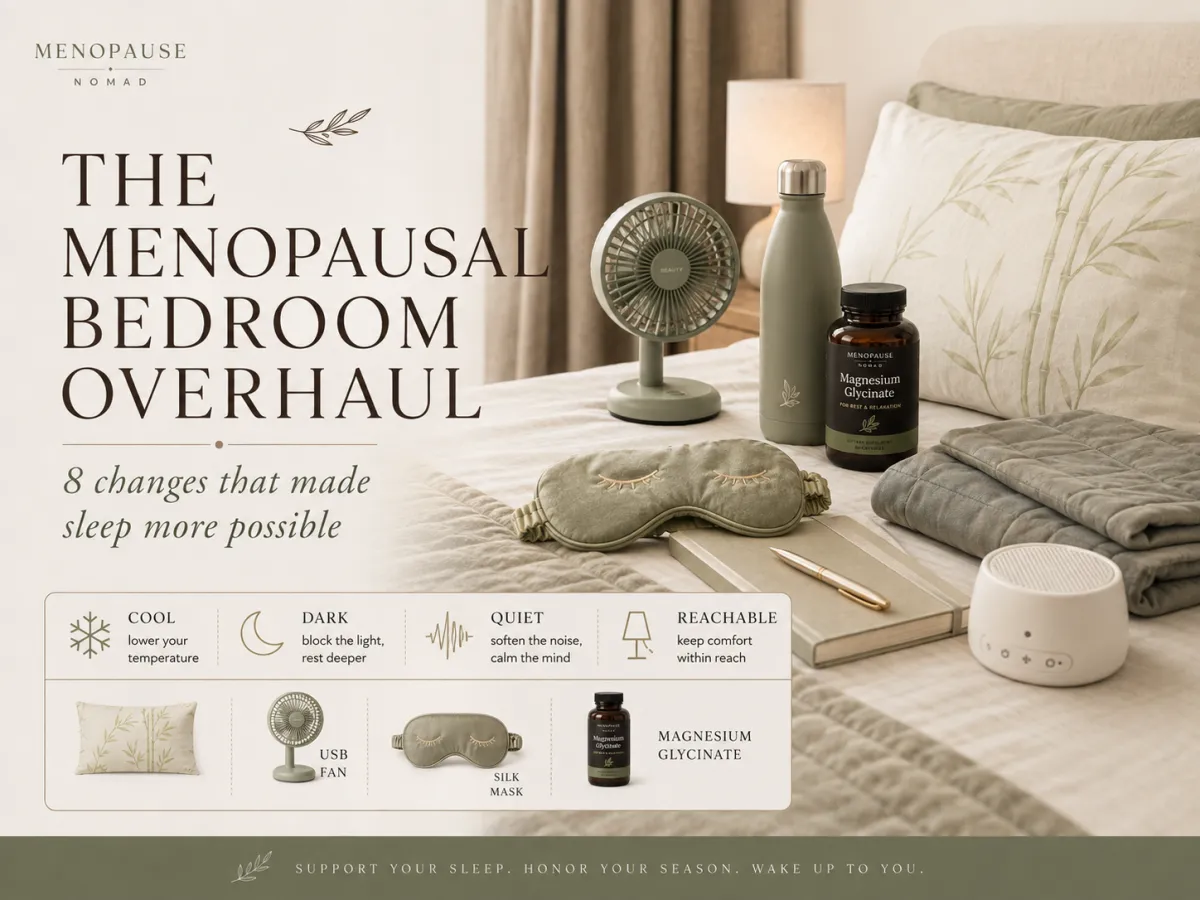
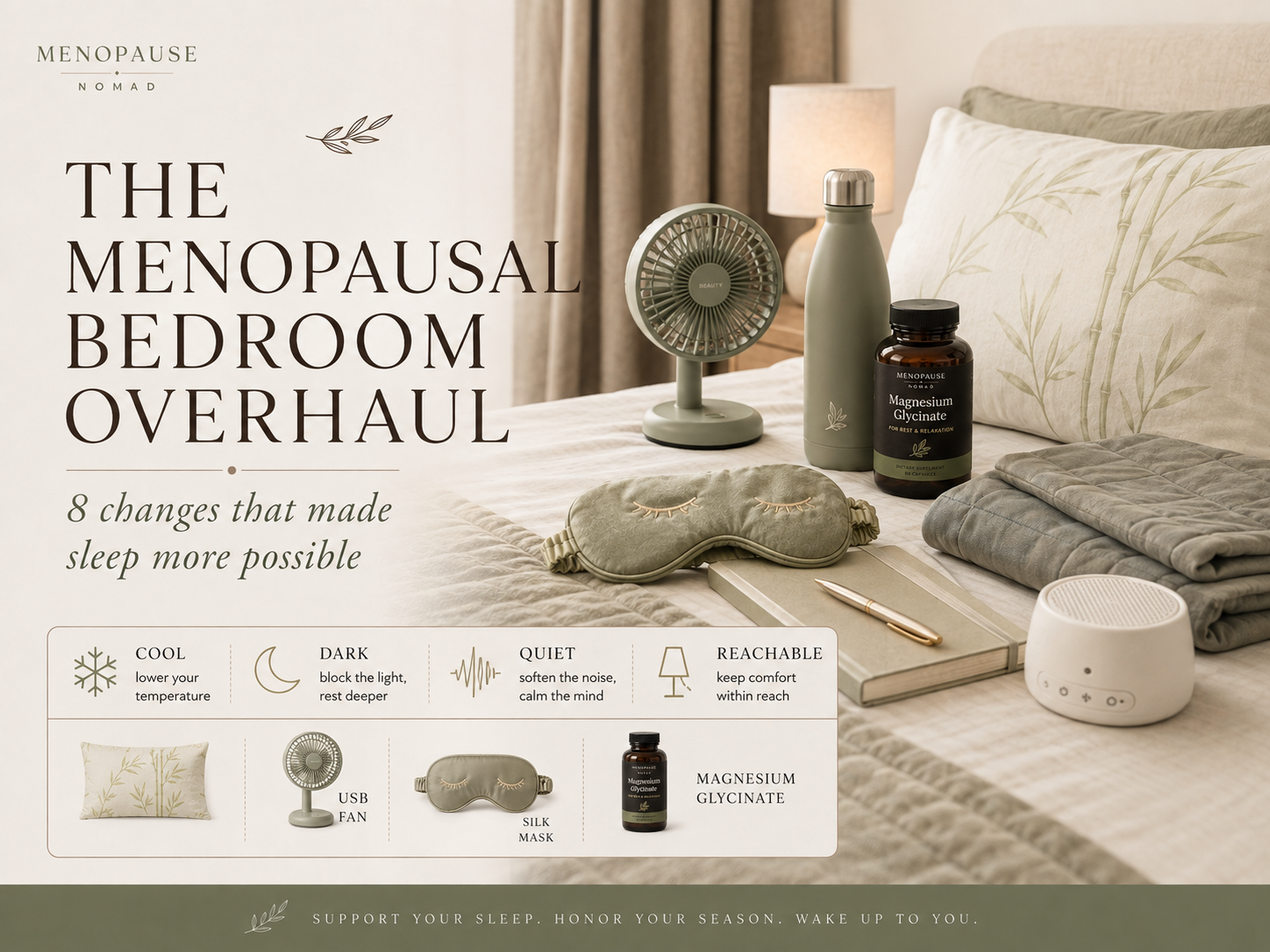
The overhaul is about accepting that your body has different requirements now, and setting up the room accordingly. Four things matter: cool, dark, quiet, and reachable.
Part 1: Temperature control (the biggest lever)
The single most important variable is bedroom temperature. Sleep researchers put the ideal around 65°F (18°C). Menopausal bodies do better closer to 62–64°F (16–17°C).
1. The cooling pillow — I tested three, one survived
I bought three cooling pillows over about six months. Two failed within a week.
The first was a memory foam pillow with a "cooling gel layer" that felt cool for approximately eleven minutes before becoming a warm memory foam pillow with a wet layer.
The second was an all-latex pillow that stayed cool longer but was the wrong shape for a side sleeper. It also weighed about eight pounds, which I mention only because it fell off the bed at 4 AM one Tuesday and startled the dog.
The third — and the one still on my bed — is a gel-infused pillow with a phase-change cover. Phase-change material is the same tech NASA developed for astronaut suits. It absorbs heat as your body warms and releases it when you cool down. It doesn't stay cold. It stays cool, which is a different and more useful thing.
Pair it with a bamboo pillowcase — cheaper than silk, wicks better than cotton, washes without complaint.
2. A cooling mattress topper (if your mattress runs hot)
If your mattress is memory foam and more than three years old, it's part of the problem. Memory foam traps heat by design.
You do not need a new mattress. You need a cooling mattress topper — a $150 fix for a $2000 problem.
Look for phase-change material or gel infusion. Skip anything marketed as "plush" or "pillow top" — those add insulation, which is the opposite of what a menopausal body needs.
3. A USB bedside fan
Sounds ridiculous until you've used one. A small rechargeable USB fan sits on your nightstand, pointed at your face and chest, and turns on with one tap when a hot flash starts.
Silent. No cord. No getting up. No waking your partner.
The three-inch models are enough. You do not need the industrial version.
Part 2: The bedside kit (seven items, arm's reach)
Getting out of bed at 4 AM to hunt for anything is how a five-minute wake-up becomes a two-hour one. Everything you might need should be within arm's reach.
Here's what's on my nightstand:
Insulated water bottle — stays cold all night, sipped when the wake-up starts, ends about half of them
Magnesium glycinate — taken at 9 PM, but the bottle stays bedside so I don't skip it
Magnesium spray — sprayed on calves when they cramp (which they now do, apparently)
Silk sleep mask — blocks the false-morning light signal from streetlights and appliance LEDs
USB fan (see above)
A paper book — screens are a trap at 4 AM; something boring on paper resets the brain
A small notebook and pen — for writing down the 4 AM thought so you can stop thinking about it and go back to sleep
That's it. Everything within reach. Nothing requires standing up.
The single most under-appreciated item on that list is the notebook. The 4 AM brain will present you with a genuinely important-feeling thought — usually about a work project or a conversation from six months ago. Writing it down (four words is enough) tells your brain the thought is safe and it can stop rehearsing it.
One thing worth wearing to bed
If cotton pajamas are keeping you awake, bamboo or wick-away sleepwear is the single easiest swap. It moves moisture off the skin so a night sweat doesn't wake you up in wet fabric.
Part 3: Light and sound control
Menopausal sleep is fragile. The wake-ups don't need much to become permanent — a passing car, a change in light, the fridge cycling on. The bedroom needs to be closer to a cave than most of us are willing to admit.
4. Blackout curtains (yes, the real ones)
I mocked blackout curtains for years. I thought they were for people with issues.
I now have issues.
Thermal blackout curtains do two jobs. They block 99% of outside light — streetlights, dawn, neighbors' porch lights, the LED on the smoke alarm you can't unplug — and they insulate against summer heat. In Alberta in July, that second job matters as much as the first.
Buy them long enough to puddle at the floor. Any gap at the bottom lets in light, which lets in cortisol, which lets in the 4 AM wake-up.
5. A white noise machine
If you have a partner who snores, a furnace that cycles, a fridge that hums, or a neighborhood with any traffic at all, a white noise machine will change your life.
I use one set to brown noise — lower frequency than white, sounds like distant surf. It masks intermittent sounds without becoming its own noise problem. Menopausal ears are somehow more sensitive; brown noise is easier on them.
6. A weighted cooling blanket
Weighted blankets help with pre-sleep anxiety. Standard weighted blankets are also insulating disasters for hot bodies.
A cooling weighted blanket — bamboo or cotton fill, glass beads instead of plastic — gives you the calming pressure without the heat trap. Use it for the first hour, then push it off if you get warm. It's a wind-down tool, not something you sleep under all night.
Part 4: Air quality (the one nobody mentions)
7. A bedroom air purifier
Menopausal sleep is more sensitive to allergens, dry air, and off-gassing than pre-menopausal sleep was. A HEPA air purifier running on low in the bedroom is the closest thing to a "hack" in this whole list.
It also produces about 40 decibels of pink noise, which doubles as sound masking. Two problems, one appliance.
8. The temperature-drop bedtime habit
The eighth change isn't a product. It's a routine: drop the bedroom to its coldest setting an hour before you get in bed.
Your body needs to shed about 1°F of core temperature to fall asleep. A cold room helps that happen faster. Get in bed slightly cool — not comfortably warm — and you'll fall asleep 10–15 minutes faster.
What didn't work
Chilled bedding sprays. Fine as ritual. Evaporate too fast to matter.
Water-cooled mattress pads (Chilipad-style). They work, but they're expensive, loud, and add a machine to your bedroom that requires maintenance. If you have $500 to spend, spend it on a new mattress and topper first.
Ceiling fans on high. Dry out your sinuses. Wake you up when they oscillate. A directional bedside fan works better.
Aromatherapy. Placebo. Not knocking placebo — just don't expect more.
"Menopause sleep tea" blends. Fine to drink. Not doing anything a chamomile bag wouldn't do at a quarter of the price.
The bottom line
The bedroom that worked for pre-menopausal you is fighting current-you. Fix the four things menopausal bodies actually need — cool, dark, quiet, and reachable — and sleep changes within a couple of weeks.
You don't need to do all eight at once. If you're starting fresh, the order I'd do them:
Cooling pillow + bamboo pillowcase
Bedside kit basics (water bottle, magnesium, silk mask, USB fan)
Cooling mattress topper
Bamboo sleepwear
Air purifier
Total investment for the first four (which do about 80% of the work): around $200.
That's a cheap fix for the most exhausting problem in menopause.
FAQ
What temperature should a menopausal bedroom be? Sleep researchers recommend 65°F (18°C) for general sleep, but menopausal bodies do better around 62–64°F (16–17°C), especially during hot flash seasons.
Do cooling pillows actually work for hot flashes? Phase-change material and gel-infused pillows work best. Basic memory foam pillows marketed as "cool" typically stay cool for under 15 minutes before absorbing body heat.
Are blackout curtains worth it for menopause sleep? Yes. Menopausal cortisol curves are sensitive to any light exposure, and even small amounts of light through thin curtains can trigger early wake-ups. Buy curtains long enough to puddle at the floor to close the gap where dawn creeps in.
What should be on the nightstand of a menopausal woman? Insulated water bottle, magnesium glycinate, silk sleep mask, USB bedside fan, a paper book, a small notebook and pen, and a magnesium spray for night cramps.
Do weighted blankets help with menopause? Weighted blankets can help pre-sleep anxiety, but standard weighted blankets trap heat and worsen night sweats. Look for cooling weighted blankets specifically designed for hot sleepers — bamboo or cotton fill with glass beads.
Is it worth buying a new mattress for menopause? Usually not as a first step. A cooling mattress topper solves the heat problem for about a tenth of the cost. Only replace the mattress if it's over eight years old or has structural issues.
Nothing in this post is medical advice. It's what worked for me. Your doctor and your body know things I don't.
This post contains affiliate links. If you buy through them, I earn a small commission at no cost to you. I only recommend things I actually use.

Subscribe to our Mailing List
And that's just a peek at what we offer. Get more marketing tips straight to your inbox.
Who's writing this:
I'm not a menopause expert, a travel expert, or an expat-life guru. I'm a 51-year-old woman who spent her career in corporate, lost her dad recently, is dealing with HRT that may or may not be working, and decided the next chapter is going to be lived somewhere with better light and slower mornings. I'm documenting all of it on Instagram and Pinterest as @menopausenomad. The checklist is one piece. The journey is the rest.
The Honest Carry-On Checklist for Menopausal Women
23 items I actually pack. 7 I stopped bringing. Written by a 51-year-old who travels carry-on only and is figuring out menopause in real time.
What's In The Checklist?
The 23 items I won't fly without (with brand-agnostic notes)
The 7 things I packed for years and finally stopped bringing
What goes in the personal item vs. the carry-on (the menopause edit)
The cooling/sleep kit that lives at the top of the bag for a reason
A printable one-page version for the women who like a paper checklist (it's most of you)
Why I Started Menopause Nomad
If you've ever stood in front of a hotel mirror at 3 a.m. wondering why no one warned you about this part of menopause — this is for you.


I’m 51. After nearly three decades in corporate leadership, I found myself asking a bigger question:
Where do I actually want to spend the next chapter of my life?
Right now, that answer may be Cyprus. Or Crete. I haven’t decided yet.
What I do know is this: menopause changed far more than my body. It changed how I want to live, work, travel, and move through the world.
I’m building toward a slower, more intentional life abroad while navigating hot flashes that ignore itineraries, sleep that now requires strategy, and a body that suddenly negotiates every carry-on item.
I’ve always traveled carry-on only.
Menopause renegotiated the contents.
The checklist I created isn’t influencer packing fantasy or affiliate-stuffed perfection. It’s the real list — what actually helps, what didn’t work, and what I stopped bringing entirely.
If you’re somewhere between “I wonder if I could do this” and “I’m actually doing this,” I made this for you.
Testimonials
What others are saying

"Excellent service!"
Excellent service! They take care of everything from cleaning to maintenance, making managing my vacation rental completely stress-free. Highly recommend!


"Highly recommend this"
"Testimonial lorem ipsum dolor sit amet, consectetur adipisicing elit. Autem dolore, alias, numquam enim dolor elit." - Your Name
" Impressed with their professionalism"
I’ve been so impressed with their professionalism and attention to detail. The in-house cleaning and maintenance teams are outstanding, and I’ve seen a noticeable difference in guest satisfaction.
"Hassle free process"
They handle everything seamlessly! I no longer worry about the upkeep of my rental, and their prompt communication has made the entire process hassle-free.
Testimonials

John Doe
Lorem ipsum dolor sit amet, consectetur adipiscing elit, sed do eiusmod tempor incididunt ut labore et dolore magna aliqua. Ut enim ad minim veniam, quis nostrud exercitation ullamco laboris nisi ut aliquip ex ea commodo consequat.


Jane Doe
Lorem ipsum dolor sit amet, consectetur adipiscing elit, sed do eiusmod tempor incididunt ut labore et dolore magna aliqua. Ut enim ad minim veniam, quis nostrud exercitation ullamco laboris nisi ut aliquip ex ea commodo consequat.
Get In Touch With Us
Phone:
(780) 882-9763
Shop:
Site 4 Comp 3 RR 3, Rimbey AB T0C 2J0
Email:
Email: [email protected]
Site: www.menopausenomad.com