Menopause Changed More Than My Body
It changed how I wanted to live, work, travel, and spend the next chapter of my life.
The Menopause Morning Brain — Fog, Dread, and the 20-Minute Reset That Actually Works
This post contains affiliate links. If you buy through them, I earn a small commission at no cost to you. I only recommend things I actually use.
The 6 AM feeling is not a mood. It's a chemistry class.
There's a specific dread that arrives in menopause before you're fully awake — a vague sense that something is wrong that resolves, on inspection, into: nothing, actually. Just estrogen.
There's a specific fog that arrives with it — the one where you cannot find your car keys, the word "toaster," or the name of the person you had coffee with last Tuesday. It is not dementia. It is not you falling apart. It is your brain trying to run on hormones that have moved out.
For years, I thought the 6 AM dread was my life. Turns out, my life was fine. The dread was pharmacology.
Here is what is actually happening to the menopause morning brain, why the usual advice ("just meditate") doesn't work, and the 20-minute reset that does. Plus the journaling section for people who — reasonably — hate journaling.
What's happening to the menopause morning brain
Three things collide before 7 AM in a menopausal body.
Estrogen supports the mood-chemistry team. Serotonin, dopamine, and GABA — the neurotransmitters that regulate mood, motivation, and calm — all depend on estrogen for production and receptor sensitivity. When estrogen drops, they drop too. Mornings, when hormones are naturally at their lowest, are when you feel it most.
Cortisol spikes earlier and harder. As covered in Why You Wake Up at 4 AM in Menopause, the loss of estrogen's buffering effect means cortisol fires earlier and steeper. High cortisol + low mood chemistry = a feeling that reads exactly like anxiety, without any anxiety-worthy input.
Sleep debt compounds it. Even one night of fragmented sleep amplifies inflammatory markers in the brain. Menopausal women rarely have just one bad night — they have a chronic sleep deficit that shows up as brain fog. The fog and the dread are related but different problems.
Named correctly, both are addressable. Named as "I'm losing it," they are not.
Part 1: The 6 AM dread (it's not anxiety)
The first move is a reframe.
Clinical anxiety has a story. There is something you're worried about — a work presentation, a difficult conversation, a health scare. Even irrational anxiety attaches itself to a target.
Menopause morning dread has no target. You wake up feeling terrible about nothing in particular. You scan for the reason. You find nothing. And then — because the brain doesn't tolerate a feeling without a story — you manufacture a reason. You start rehearsing a mistake you made in 2019. You spiral about your kid's future. You catastrophize about work.
None of it is real. It's your nervous system looking for a coat rack to hang the dread on.
The intervention:
Name it before you engage with it. Out loud is best. "This is chemistry. Nothing is wrong." That single sentence shortcuts the loop. You're not lying to yourself; you're accurately labeling the input.
Do not check your phone. The first thing you look at trains your nervous system on what to be alarmed about. Email at 6 AM in a dread state is how a 90-second wake-up becomes a 3-hour anxiety loop.
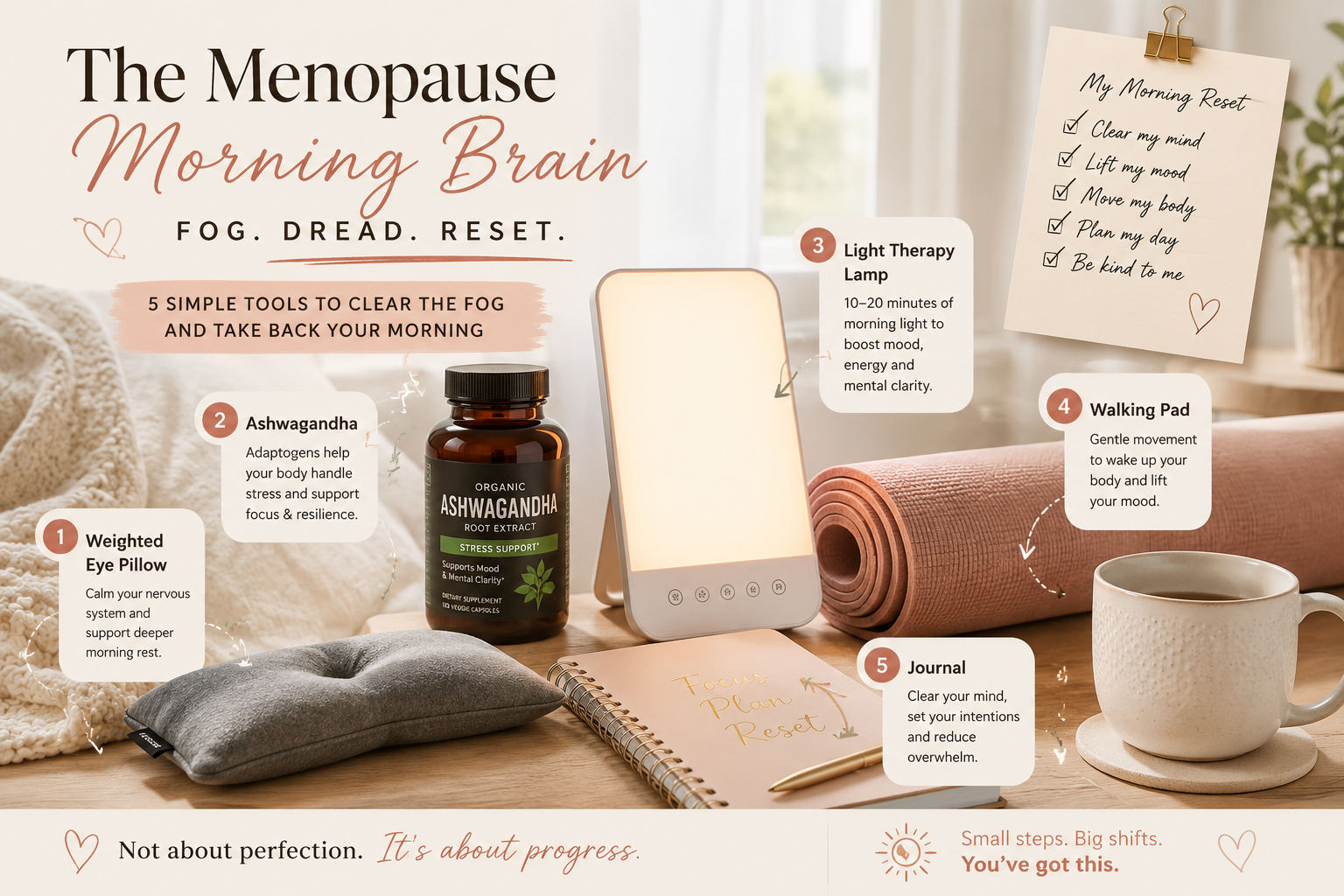
A weighted eye pillow — 10 minutes lying still with gentle pressure over the eyes lowers cortisol measurably. Not a miracle. A 15% shift. Enough to reset the loop.
Warm liquid before caffeine. A cup of herbal calming tea — chamomile, lemon balm, tulsi — before coffee gives the nervous system a signal that it's safe. Coffee on top of morning cortisol makes the dread worse.
Ashwagandha (KSM-66), 300–600mg taken at night. Ashwagandha is one of the few supplements with real evidence for cortisol regulation in women. It doesn't work in the morning; it works overnight, lowering the cortisol spike that arrives at 6 AM. Give it two weeks before you decide.
One caveat on ashwagandha: it can interact with thyroid medication and is not recommended in autoimmune thyroid conditions. If you have Hashimoto's or take levothyroxine, check with your doctor first.
If the dread is happening every morning and it's been going on for months, or if it's tied to any thoughts of self-harm, this isn't a menopause routine problem — it's a "talk to a doctor" problem. The chemistry framing is not a substitute for evaluation when it's needed.
Part 2: Brain fog is a different animal
Dread is a hormonal state. Fog is a cognitive one. They show up together but respond to different interventions.
Menopausal brain fog has three drivers:
Estrogen loss affects the hippocampus (memory) and prefrontal cortex (word-finding, focus)
Poor sleep amplifies inflammatory markers that impair working memory
Inconsistent morning light delays the alertness signal your brain uses to sharpen up
The good news: fog is not permanent, and it responds fast to input. The 20-minute morning reset addresses all three drivers.
Part 3: The 20-minute morning reset
Not a cold plunge. Not breathwork with an app. Not a 45-step ritual with a matcha ceremony.
Four things. Twenty minutes. Reproducible on the worst day of the week.
Minutes 0–3: Water and light. A tall glass of water before anything else. Then open the blinds or step outside for two minutes. Morning light in the eyes tells the brain "it's day," which starts the alertness cascade. Two minutes of natural light does more for morning fog than 45 minutes of coffee.
If you're up before sunrise — Alberta in winter, most of the world in December — a 10,000-lux light therapy lamp run for 20 minutes over breakfast is the workaround. Blue-light-blocking glasses in the evening; bright light in the morning. Same tool, opposite direction.
Minutes 3–13: Movement without intensity. Ten minutes of movement. Not a workout. Not cardio. Just moving.
The best cheap tool for this is a walking pad under a standing desk — 10 minutes at 3 km/h while you do email, drink water, look at the sky. If you don't have room for a walking pad, a real 10-minute walk outside beats it. If you don't have that, marching in place while the kettle boils is enough.
Movement clears brain fog by increasing cerebral blood flow. That's it. It doesn't need to be beautiful. It needs to happen.
Minutes 13–18: Warm drink, protein snack. Not coffee first. Coffee comes later, as covered in the morning body protocol. A cup of adaptogenic morning tea — tulsi, ashwagandha (evening), or a licorice root blend — supports the nervous system without spiking cortisol. Something with protein alongside: yogurt, a boiled egg, a slice of last night's chicken. The brain runs on stable blood sugar, not sugar spikes.
Minutes 18–23: The journal. Five minutes. Three prompts. See Part 4.
That's the full reset. Twenty-three minutes if you're being precise. It survives the worst mornings because it isn't demanding — no chanting, no ice, no willpower required.
Part 4: Journaling for people who hate journaling
I have started three journals. I have finished none of them.
Standard journaling advice — write three pages every morning, list ten things you're grateful for, describe your feelings in detail — is written for people who enjoy journaling. If you are not one of those people, doing it their way is how you fail at it for the fourth time and then decide you're not a "journaling person."
Here is the version that works for people who don't like feelings on paper.
Three prompts. Five minutes. No feelings required.
What's actually on my plate today? Not the to-do list — the load. Two or three items. This is what tells your nervous system it can stop rehearsing.
What's the one thing? Out of everything on the plate, the one thing that would make today count if only one thing got done.
What don't I need to think about anymore? The mental tabs you can close. The email you already responded to. The conversation you already had. The decision you already made. Write them down so you can stop looking for them.
That's it. Five minutes. No gratitude. No feelings unless you happen to have any handy.
The physical setup matters more than people admit.
A simple lined notebook — nothing fancy, ideally cheap so you're not precious with it — and a pen you actually like writing with beat a $40 gratitude journal every time. The pen is the whole trick. If it's a good pen, you'll write. If it's a scratchy hotel-lobby pen, you won't.
If you want structure and prompts, the Five Minute Journal is the least annoying pre-made option. It's built for people who don't want to think about what to write. Some of the prompts are a little wellness-influencer for my taste — you can skip them. The structure is what matters.
I don't recommend gratitude journals as a starting point in menopause. When the 6 AM dread is running, being asked "what are you grateful for?" can trigger a shame loop ("I should feel grateful and I don't"). Once the reset is working, gratitude prompts are fine. Not before.
What didn't work
Meditation apps. I tried three. The narrator's voice at 6 AM in a dread state made things worse for me. Some people find them useful. I am not one of them.
Cold showers and cold plunges. Adds a stress response to a stress response. Some men in wellness culture love this. I have not met a menopausal woman it actually helped. Skip it.
Breathwork with elaborate protocols. Basic long exhales work. The four-part complicated stuff is overkill for morning brain fog and adds cognitive load to a brain that's already foggy.
Journaling every morning. Turns out three times a week is enough. Every day is a burden that gets abandoned by month two.
Melatonin the night before. Doesn't affect the morning dread. Affects the sleep architecture, sometimes badly. Low-dose (0.3mg) is fine if you use it; high-dose store-bought (3–10mg) is where it stops helping.
Coffee before the reset. Doesn't fix the fog. Amplifies the dread. Move coffee to after the 20-minute reset and both problems improve within a week.
The bottom line
The menopause morning brain is not a personal failing. It is a chemistry situation with a workable intervention.
The stack, in order:
Name it — this is chemistry, not a mood
Water and light — 3 minutes
Movement without intensity — 10 minutes
Warm drink and protein — 5 minutes
The three-prompt journal — 5 minutes
Total: 23 minutes. Every step earns its spot. None of them require becoming a different person.
At night: ashwagandha if it agrees with you, no phone in bed, blackout mask on, water on the nightstand.
If the dread doesn't lift within 3–4 weeks of consistent practice, or if it's paired with persistent low mood, hopelessness, or thoughts of self-harm, please talk to a doctor. Menopause and clinical depression can look identical in the mirror, and one of them needs medical care, not a walking pad.
FAQ
Is morning anxiety a symptom of menopause? Yes. The combination of dropping estrogen (which supports serotonin, dopamine, and GABA) and rising morning cortisol produces a state that feels like anxiety but has no external cause. It's often called "menopause morning dread" and is one of the most common perimenopause symptoms.
How do I stop waking up with anxiety in menopause? The most effective interventions target the underlying chemistry: morning light within the first hour of waking, delayed caffeine, warm liquid before coffee, and evening ashwagandha (if not contraindicated). Naming the feeling as chemistry rather than reacting to it as a threat shortcuts the anxiety loop.
Is brain fog in menopause permanent? No. Menopausal brain fog is driven by estrogen decline, poor sleep, and inflammation — all of which are modifiable. Most women see meaningful improvement in cognitive symptoms within a few months of addressing sleep, light exposure, and morning routines.
How is menopause brain fog different from dementia? Menopause brain fog affects word-finding, working memory, and focus, and it fluctuates day to day. It doesn't progressively worsen over months and years. If cognitive symptoms are progressive, worsen with familiar tasks, or include getting lost in familiar places, that warrants a medical evaluation.
Does ashwagandha really help menopause anxiety? Multiple studies show KSM-66 ashwagandha (300–600mg daily) reduces morning cortisol in women. It's most effective taken in the evening. Not recommended with thyroid medication or autoimmune thyroid conditions — check with a doctor first.
Should I journal every day in menopause? Three times a week is enough for most people, and it's more sustainable than daily practice. Skip daily gratitude journaling in early menopause — it can trigger shame loops when the dread is running. Structured prompts (what's on my plate, what's the one thing, what can I stop thinking about) work better than open-ended journaling.
What's the best morning routine for menopause brain fog? Water, morning light, gentle movement, warm drink with protein, and five minutes of writing. Twenty to twenty-five minutes total. Coffee comes after, not before. Cold plunges and elaborate breathwork are not required.
Nothing in this post is medical advice. It's what worked for me. If morning dread or brain fog is severe or persistent, please talk to a doctor.

Subscribe to our Mailing List
And that's just a peek at what we offer. Get more marketing tips straight to your inbox.
Who's writing this:
I'm not a menopause expert, a travel expert, or an expat-life guru. I'm a 51-year-old woman who spent her career in corporate, lost her dad recently, is dealing with HRT that may or may not be working, and decided the next chapter is going to be lived somewhere with better light and slower mornings. I'm documenting all of it on Instagram and Pinterest as @menopausenomad. The checklist is one piece. The journey is the rest.
The Honest Carry-On Checklist for Menopausal Women
23 items I actually pack. 7 I stopped bringing. Written by a 51-year-old who travels carry-on only and is figuring out menopause in real time.
What's In The Checklist?
The 23 items I won't fly without (with brand-agnostic notes)
The 7 things I packed for years and finally stopped bringing
What goes in the personal item vs. the carry-on (the menopause edit)
The cooling/sleep kit that lives at the top of the bag for a reason
A printable one-page version for the women who like a paper checklist (it's most of you)
Why I Started Menopause Nomad
If you've ever stood in front of a hotel mirror at 3 a.m. wondering why no one warned you about this part of menopause — this is for you.


I’m 51. After nearly three decades in corporate leadership, I found myself asking a bigger question:
Where do I actually want to spend the next chapter of my life?
Right now, that answer may be Cyprus. Or Crete. I haven’t decided yet.
What I do know is this: menopause changed far more than my body. It changed how I want to live, work, travel, and move through the world.
I’m building toward a slower, more intentional life abroad while navigating hot flashes that ignore itineraries, sleep that now requires strategy, and a body that suddenly negotiates every carry-on item.
I’ve always traveled carry-on only.
Menopause renegotiated the contents.
The checklist I created isn’t influencer packing fantasy or affiliate-stuffed perfection. It’s the real list — what actually helps, what didn’t work, and what I stopped bringing entirely.
If you’re somewhere between “I wonder if I could do this” and “I’m actually doing this,” I made this for you.
Testimonials
What others are saying

"Excellent service!"
Excellent service! They take care of everything from cleaning to maintenance, making managing my vacation rental completely stress-free. Highly recommend!


"Highly recommend this"
"Testimonial lorem ipsum dolor sit amet, consectetur adipisicing elit. Autem dolore, alias, numquam enim dolor elit." - Your Name
" Impressed with their professionalism"
I’ve been so impressed with their professionalism and attention to detail. The in-house cleaning and maintenance teams are outstanding, and I’ve seen a noticeable difference in guest satisfaction.
"Hassle free process"
They handle everything seamlessly! I no longer worry about the upkeep of my rental, and their prompt communication has made the entire process hassle-free.
Testimonials

John Doe
Lorem ipsum dolor sit amet, consectetur adipiscing elit, sed do eiusmod tempor incididunt ut labore et dolore magna aliqua. Ut enim ad minim veniam, quis nostrud exercitation ullamco laboris nisi ut aliquip ex ea commodo consequat.


Jane Doe
Lorem ipsum dolor sit amet, consectetur adipiscing elit, sed do eiusmod tempor incididunt ut labore et dolore magna aliqua. Ut enim ad minim veniam, quis nostrud exercitation ullamco laboris nisi ut aliquip ex ea commodo consequat.
Get In Touch With Us
Phone:
(780) 882-9763
Shop:
Site 4 Comp 3 RR 3, Rimbey AB T0C 2J0
Email:
Email: [email protected]
Site: www.menopausenomad.com