
Menopause Changed More Than My Body
It changed how I wanted to live, work, travel, and spend the next chapter of my life.

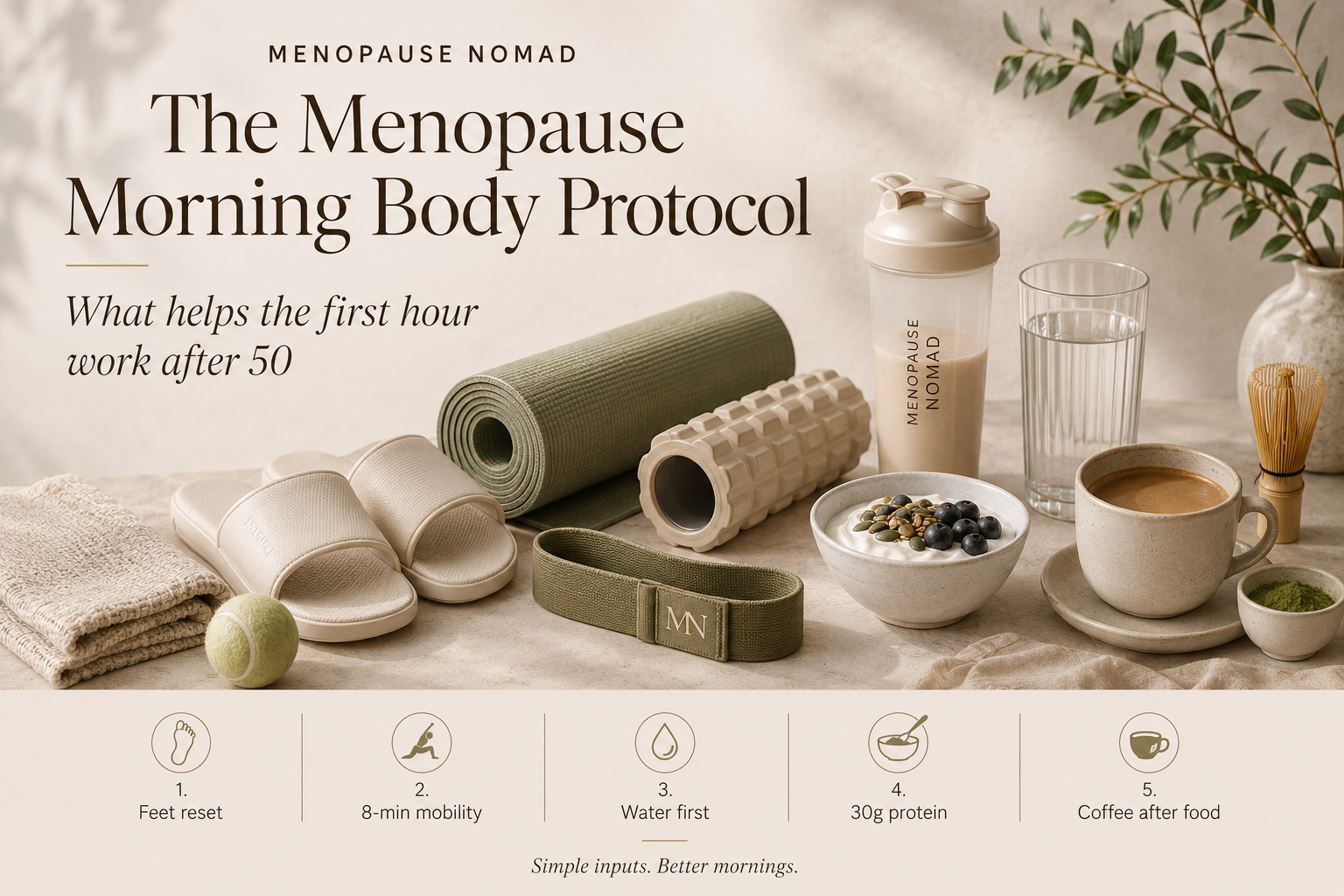
The Menopause Morning Body Protocol: The First Hour That Actually Works
My body used to wake up in about ninety seconds.
Now it wakes up like it's been in a minor car accident. Feet on the floor: negotiations. Hips: filing a complaint. Lower back: consulting counsel. By the time everything is upright, my kettle has finished and I have missed the window to feel human before my first meeting.
The first hour after waking is not a small thing for a menopausal body. It's the entire day, set in motion. Get it wrong and you're playing catch-up until noon. Get it right and you're — well, you're a person who slept badly but is functioning, which is the current definition of a good day.
Here's the sequence that actually works. It takes about sixty minutes. You'll do about half of it while barely awake, which is the point.
Why the menopause morning is different
Three things happen to the body in perimenopause and menopause that make the standard "wake up and go" model stop working.
Muscle mass drops. Women lose roughly 3–8% of muscle per decade after 30, and it accelerates when estrogen drops. Less muscle means the body cools less efficiently, moves less easily, and needs specific inputs — mainly protein and resistance — to hold the ground it has left.
Fascia stiffens. Estrogen keeps connective tissue supple. Without it, the network of tissue wrapping your muscles gets sticky. That's why nothing hurt when you got out of bed at 42 and everything hurts now.
Insulin sensitivity drops. The body handles carbs and protein differently now. Skipping breakfast used to feel disciplined. It now feels like sabotage — because it is.
The first-hour protocol is designed around those three facts. Every step earns its spot.
Minute 0–10: The feet
The single biggest surprise of my mid-forties was that my feet started hurting every morning.
Not a little. A limp-across-the-bedroom, sit-on-the-edge-of-the-bed-flexing-my-foot kind of hurt. My doctor called it plantar fasciitis. What she meant, though nobody said it out loud, was: your fascia is aging.
Three things fixed it in about two weeks:
A tennis ball at bedside. Before you stand up, roll each foot on a tennis ball for 60 seconds. Sitting on the edge of the bed. That's it. The fascia releases and the first step doesn't hurt.
Recovery slides for the first ten minutes. Arch-support recovery slides at the bedside mean your first steps aren't barefoot on a hard floor. Skipping this makes everything else worse.
Toe spacers, at night. Silicone toe spacers look ridiculous and work anyway. Wear them for an hour in the evening while reading. They reset how your foot lands.
Cost of the full foot rescue: about $40. Effect: measurable within a week.
Minute 10–25: The 8-minute mobility routine
This is the section where I tell you not to stretch.
Static stretching first thing in the morning does very little for menopausal fascia. What works is mobility — moving joints through their full range with a bit of load. Eight minutes is enough if you do the right eight minutes.
The sequence, on a thick yoga mat (menopausal knees do not enjoy 3mm mats):
Cat-cow — 90 seconds. Wakes up the spine.
Hip circles on all fours — 60 seconds each direction. The single most effective move for morning hip stiffness.
Thread the needle — 45 seconds each side. Thoracic spine, which no longer rotates on its own.
World's greatest stretch — 3 reps each side. Deep hip flexor + spine rotation.
Glute bridges — 15 reps. Wakes up the posterior chain.
Band pull-aparts with a resistance loop — 15 reps. Shoulders, which have started to hunch.
Foam roller on the upper back, travel-size roller — 60 seconds.
Slow bodyweight squats — 10 reps. Wake up the legs before they have to carry you.
Eight moves. Eight minutes. No jumping, no cardio, no floor gymnastics.
The foam roller is the one item I'd buy first if I could only pick one. It handles hips, back, and IT band without any real skill required.
Minute 25–30: The scale question
Somewhere in your forties, the bathroom scale went from useful data to a bad relationship with a small machine.
Daily weighing in menopause is punishing yourself for water, hormones, salt, and time of day. The number will move 3–5 pounds over the course of a week for reasons that have nothing to do with anything you did or didn't do. Watching that number every morning trains your brain to associate mornings with disappointment.
I moved to weighing once a month, and I track two things instead:
Waist circumference with a cloth tape measure. Belly fat is the actual health marker in menopause — the one linked to metabolic risk. It changes slowly, which means you don't stare at it. Once a month, morning, before coffee. Ten seconds.
Grip strength, monthly, with a small dynamometer. Grip strength is one of the best predictors of longevity in women over 50. It's boring, useful, and reflects the muscle you're actually trying to preserve. Squeeze, record, move on.
The scale still exists in my house. It's used once a month. That's the whole rebellion.
Minute 30–40: The drink
The internet has a lot of opinions about coffee in menopause. Most of them are wrong.
Here's the actual verdict after six weeks of tracking:
Coffee before food, on an empty stomach, made hot flashes worse and made me shakier by 10 AM. That's not the caffeine's fault — it's the timing. Empty-stomach caffeine spikes cortisol, which is already high in the menopausal morning.
Coffee 30 minutes after protein and water is fine. No hot flash uptick. No 10 AM crash. Same amount of caffeine.
The fix is the sequence, not the drink. Water first. Ten minutes. Then coffee, with food or right before it.
If you want to skip caffeine for the first half of the morning, ceremonial-grade matcha with a bamboo whisk is the honest alternative. Matcha has L-theanine, which blunts the cortisol spike. It's not a coffee replacement — it's a different tool. Both stay in my rotation.
If you're a black coffee drinker, a cold brew maker drops the acidity by about 65% — noticeably easier on a menopausal gut. Brew a batch on Sunday, drink it all week.
Minute 40–60: Protein first
The single most important nutritional rule in menopause is protein in the first hour.
The number that matters is 30 grams. That's what the muscle protein synthesis research suggests you need per meal to actually build or hold muscle after 50. Below that, you're maintaining insulin sensitivity but not doing much for the muscle side.
Thirty grams sounds like a lot. It's actually:
4 eggs (24g) plus a slice of turkey (6g)
Greek yogurt (1 cup, ~20g) plus a scoop of whey isolate stirred in (~25g)
Two eggs plus cottage cheese (½ cup, ~14g)
A protein shake with whey isolate and collagen peptides if you cannot face solid food
A glass shaker bottle helps if you're doing the shake version — plastic shakers hold coffee smell forever and it's grim.
One note on collagen: peptides do not build muscle the way whey does. They're good for joints, skin, and gut lining. Use them with whey, not instead of it. The order of operations matters here — whey first, collagen as an add-on.
If you eat, the protein counts. If you drink it, a good shaker and a real protein powder count. What doesn't count: coffee with collagen and calling it breakfast. That's a snack in a mug, and the muscle math doesn't work on it.
What didn't work
HIIT workouts in the morning. Spikes cortisol at exactly the wrong time. I moved intensity to afternoons and my sleep improved within a week.
Intermittent fasting. Fine for some women. For me, at 51, it accelerated muscle loss and made afternoons brutal. The 30g-protein-first-hour rule and IF are largely incompatible.
Green powders. Fine as vitamins. Not doing what protein does.
Yoga instead of resistance training. Yoga is valuable. It is not a substitute for lifting things in menopause. The bones and muscles need load.
Long stretches on hip flexors. Felt good. Did nothing. Mobility work with movement outperforms static stretching every time in a menopausal body.
The bottom line
The first hour in menopause is the whole day compressed. Get it wrong and you're negotiating with your body until noon. Get it right and the rest of the day mostly takes care of itself.
The order that works:
Tennis ball roll for the feet (60 seconds, in bed)
Recovery slides for the walk to the kitchen
Water
Eight-minute mobility routine
Protein-first breakfast, at least 30 grams
Coffee or matcha, after the protein, not before
That's it. About 60 minutes, mostly on autopilot once it's built.
You don't need to hit all six from day one. Start with the tennis ball and the 30 grams of protein — those two alone will change how you feel by the end of the week.
FAQ
Why do my feet hurt every morning in menopause? Estrogen keeps fascia — the connective tissue wrapping muscles and tendons — supple and hydrated. When estrogen drops in perimenopause and menopause, fascia stiffens, and the plantar fascia is one of the first places you notice it. A tennis ball roll for 60 seconds before standing up usually resolves the pain within two weeks.
How much protein do menopausal women actually need? Current research suggests 30 grams per meal is the minimum threshold for muscle protein synthesis in women over 50. That's roughly 90–120 grams per day, spread across meals. The first meal of the day matters most because it breaks the overnight fast when muscle protein breakdown is highest.
Is coffee bad for menopause? Not inherently. Coffee on an empty stomach spikes cortisol at a time when menopausal cortisol is already high, which can worsen hot flashes and afternoon crashes. Coffee 30 minutes after food and water is generally fine.
Should I stop weighing myself in menopause? Daily weighing is rarely helpful in menopause because hormonal water retention makes daily numbers unreliable. Waist circumference and grip strength are better health markers. Monthly weigh-ins are enough if you want a data point.
What's the best supplement to take in the morning for menopause? Protein isn't a supplement, but it's the highest-impact morning input. If you're asking about pills: vitamin D3 with K2, magnesium glycinate at night (not morning), and creatine (3–5g daily) have the strongest evidence for menopausal women. Skip most "menopause blend" supplements — they're usually underdosed and overpriced.
Is matcha better than coffee for menopause? Matcha contains L-theanine, which blunts the cortisol spike caffeine causes. That makes it easier on menopausal mornings than coffee on an empty stomach. But coffee is fine when timed correctly. Both can stay in the rotation.
Nothing in this post is medical advice. It's what worked for me. Your doctor and your body know things I don't.
This post contains affiliate links. If you buy through them, I earn a small commission at no cost to you. I only recommend things I actually use.

Subscribe to our Mailing List
And that's just a peek at what we offer. Get more marketing tips straight to your inbox.
Who's writing this:
I'm not a menopause expert, a travel expert, or an expat-life guru. I'm a 51-year-old woman who spent her career in corporate, lost her dad recently, is dealing with HRT that may or may not be working, and decided the next chapter is going to be lived somewhere with better light and slower mornings. I'm documenting all of it on Instagram and Pinterest as @menopausenomad. The checklist is one piece. The journey is the rest.
The Honest Carry-On Checklist for Menopausal Women
23 items I actually pack. 7 I stopped bringing. Written by a 51-year-old who travels carry-on only and is figuring out menopause in real time.
What's In The Checklist?
The 23 items I won't fly without (with brand-agnostic notes)
The 7 things I packed for years and finally stopped bringing
What goes in the personal item vs. the carry-on (the menopause edit)
The cooling/sleep kit that lives at the top of the bag for a reason
A printable one-page version for the women who like a paper checklist (it's most of you)
Why I Started Menopause Nomad
If you've ever stood in front of a hotel mirror at 3 a.m. wondering why no one warned you about this part of menopause — this is for you.


I’m 51. After nearly three decades in corporate leadership, I found myself asking a bigger question:
Where do I actually want to spend the next chapter of my life?
Right now, that answer may be Cyprus. Or Crete. I haven’t decided yet.
What I do know is this: menopause changed far more than my body. It changed how I want to live, work, travel, and move through the world.
I’m building toward a slower, more intentional life abroad while navigating hot flashes that ignore itineraries, sleep that now requires strategy, and a body that suddenly negotiates every carry-on item.
I’ve always traveled carry-on only.
Menopause renegotiated the contents.
The checklist I created isn’t influencer packing fantasy or affiliate-stuffed perfection. It’s the real list — what actually helps, what didn’t work, and what I stopped bringing entirely.
If you’re somewhere between “I wonder if I could do this” and “I’m actually doing this,” I made this for you.
Testimonials
What others are saying

"Excellent service!"
Excellent service! They take care of everything from cleaning to maintenance, making managing my vacation rental completely stress-free. Highly recommend!


"Highly recommend this"
"Testimonial lorem ipsum dolor sit amet, consectetur adipisicing elit. Autem dolore, alias, numquam enim dolor elit." - Your Name
" Impressed with their professionalism"
I’ve been so impressed with their professionalism and attention to detail. The in-house cleaning and maintenance teams are outstanding, and I’ve seen a noticeable difference in guest satisfaction.
"Hassle free process"
They handle everything seamlessly! I no longer worry about the upkeep of my rental, and their prompt communication has made the entire process hassle-free.
Testimonials

John Doe
Lorem ipsum dolor sit amet, consectetur adipiscing elit, sed do eiusmod tempor incididunt ut labore et dolore magna aliqua. Ut enim ad minim veniam, quis nostrud exercitation ullamco laboris nisi ut aliquip ex ea commodo consequat.


Jane Doe
Lorem ipsum dolor sit amet, consectetur adipiscing elit, sed do eiusmod tempor incididunt ut labore et dolore magna aliqua. Ut enim ad minim veniam, quis nostrud exercitation ullamco laboris nisi ut aliquip ex ea commodo consequat.
Get In Touch With Us
Phone:
(780) 882-9763
Shop:
Site 4 Comp 3 RR 3, Rimbey AB T0C 2J0
Email:

Email: [email protected]
Site: www.menopausenomad.com