Menopause Changed More Than My Body
It changed how I wanted to live, work, travel, and spend the next chapter of my life.
Why I Started Menopause Nomad
If you've ever stood in front of a hotel mirror at 3 a.m. wondering why no one warned you about this part of menopause — this is for you.
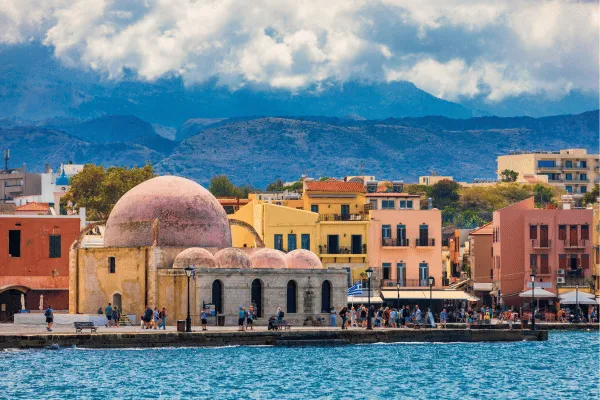
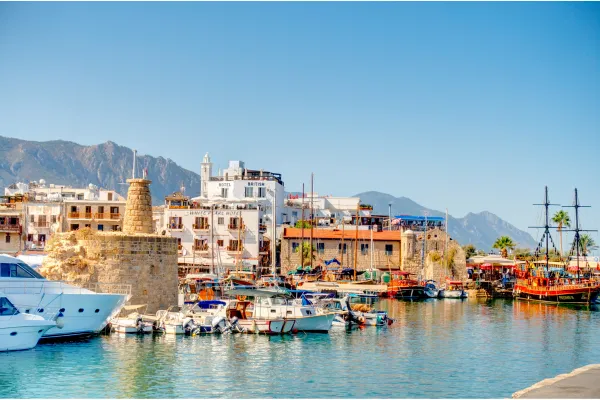
I’m 51. After nearly three decades in corporate leadership, I found myself asking a bigger question:
Where do I actually want to spend the next chapter of my life?
Right now, that answer may be Cyprus. Or Crete. I haven’t decided yet.
What I do know is this: menopause changed far more than my body. It changed how I want to live, work, travel, and move through the world.
I’m building toward a slower, more intentional life abroad while navigating hot flashes that ignore itineraries, sleep that now requires strategy, and a body that suddenly negotiates every carry-on item.
I’ve always traveled carry-on only.
Menopause renegotiated the contents.
The checklist I created isn’t influencer packing fantasy or affiliate-stuffed perfection. It’s the real list — what actually helps, what didn’t work, and what I stopped bringing entirely.
If you’re somewhere between “I wonder if I could do this” and “I’m actually doing this,” I made this for you.
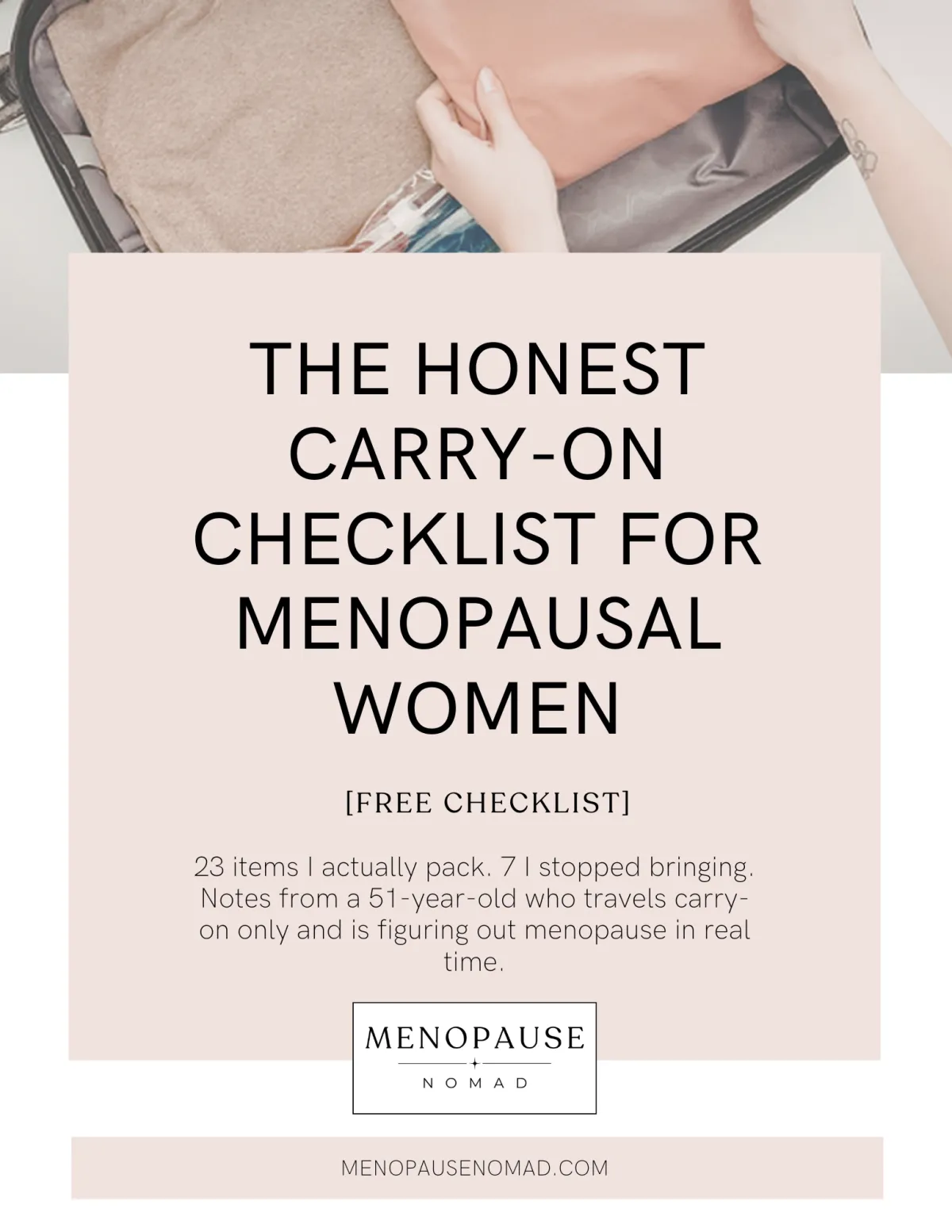
The Honest Carry-On Checklist for Menopausal Women
23 items I actually pack. 7 I stopped bringing. Written by a 51-year-old who travels carry-on only and is figuring out menopause in real time.
What's In The Checklist?
The 23 items I won't fly without (with brand-agnostic notes)
The 7 things I packed for years and finally stopped bringing
What goes in the personal item vs. the carry-on (the menopause edit)
The cooling/sleep kit that lives at the top of the bag for a reason
A printable one-page version for the women who like a paper checklist (it's most of you)
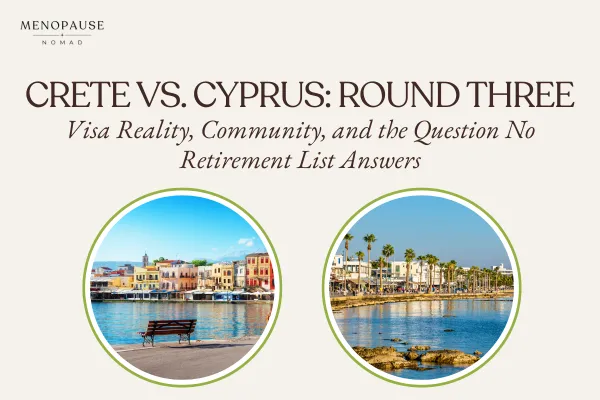
Crete vs Cyprus - Round 3
Two rounds in, here's where we are. Round 1 was about climate and healthcare, which ended in a draw. Round 2 was about money — cost of living, with Crete winning on most categories. The running score has Crete slightly ahead, but the categories left to compare are the ones that actually determine whether either move is possible.
Round 3 is the hard part.
This is where most "best places to retire abroad" lists fall apart, because the questions they skip are the questions that decide whether you can actually go. What's the visa pathway for a non-EU citizen — a 51-year-old Canadian woman building a location-independent business? What's the community really like? Will you make friends, or will you be lonely on a beautiful island? And can the internet handle a workday for a remote worker?
These aren't glamorous categories. They don't make for pretty Pinterest pins. But they're the categories that determine reality.
A note before we begin: visa and immigration policies for both Greece and Cyprus have shifted significantly in the past few years, and continue to update regularly. Everything I write below reflects my research, but you absolutely need to verify current specifics against official government sources before making any decision. Treat this as a starting framework, not legal advice. I'm not an immigration lawyer, and the visa landscape moves faster than blog content can keep up with.
The three categories for Round 3: visa pathways, community and social reality, and internet reliability for remote work. Let's get into it.
Category 1: The Visa Question
This is the single most consequential category in the entire series. Climate is preference; cost is math; visa is possibility. If you can't legally stay long-term, none of the rest matters.
For non-EU citizens (Canadians, Americans, Brits, and others outside the European Union), both Greece and Cyprus offer several long-stay pathways. The right one depends on your situation — whether you're retired, working remotely, investing, or some combination.
Greece: Visa Pathways for Non-EU Citizens
The Digital Nomad Visa. Greece introduced its Digital Nomad Visa relatively recently, and it's specifically designed for people in your situation — non-EU citizens earning income from employers or clients outside Greece. The general requirements include proof of remote employment or self-employment, a minimum monthly income threshold (which has been around €3,500/month, though this number has been adjusted, so verify the current threshold), private health insurance, and a clean criminal record.
The visa is typically granted for 12 months initially with renewal options. After several years of legal residency, paths to permanent residency and eventually citizenship may open up, though these timelines are long (typically 5-7+ years of continuous residency for permanent residency, longer for citizenship).
The Golden Visa. Greece's Golden Visa program grants residency in exchange for property investment. The minimum investment threshold has shifted significantly — it was historically €250,000 but has been raised in popular zones (including parts of Athens) to €500,000 or even €800,000 depending on location. Crete is currently in the lower-threshold zone, but this could change. This is a serious financial commitment but offers the most secure long-term residency path for those who can manage it.
Type D Long-Stay Visa. A more traditional long-stay visa for those who can demonstrate sufficient financial means without needing to work in Greece. Typically requires proof of stable passive income or savings that can support you without burdening the Greek system. Less flashy than the Golden Visa, less specific than the Digital Nomad Visa, but a viable path for retirees or semi-retirees with sufficient resources.
Important verification note: All three of these programs have had threshold changes, application process updates, and policy shifts in the past 3 years. Before relying on any specific number or requirement, check the current Greek consulate website for your country of residence and consider consulting with a Greek immigration attorney for serious moves.
Cyprus: Visa Pathways for Non-EU Citizens
The Digital Nomad Visa. Cyprus also introduced a Digital Nomad Visa specifically for non-EU remote workers. Similar structure to the Greek version — proof of remote employment or self-employment, monthly income threshold (which has been around €3,500/month, with similar caveats about verification), health insurance, and background checks. Initial residency typically granted for one year with renewal options.
Permanent Residence Permit, Category F. This is the more traditional Cypriot path for non-EU retirees or semi-retirees. It's designed for people with stable income from outside Cyprus (pension, investments, passive income) who can support themselves without working in Cyprus. The requirements include proof of stable income (the threshold varies but is generally in the range of €30,000-50,000 annually depending on family size), private accommodation arrangements (renting or owning property in Cyprus), and not seeking employment in Cyprus.
Category F can be a strong path for retirees, and historically Cyprus has been considered slightly more straightforward than Greece for the traditional long-stay residency route.
Investment-Based Residency. Cyprus has historically had various investment-based residency programs, though the high-profile "Cyprus Investment Programme" (which granted citizenship through investment) was discontinued in 2020. Other investment-based residency options exist but have shifted significantly. This is the area where current verification matters most because the landscape has changed substantially in recent years.
Round Verdict on Visa Pathways
This is one of the few categories where Cyprus has a meaningful edge, and it's because of the Category F Permanent Residence pathway. For a 51-year-old non-EU woman with stable income from a location-independent business, Cyprus offers a relatively clearer and more established long-stay path than Greece does.
Greece's Digital Nomad Visa is real and viable, but it's newer, the policies are still being refined, and the renewal/permanent residency paths are less predictable.
Cyprus's overall framework, particularly for retirees or semi-retirees with sufficient stable income, is more established and predictable.
The honest caveat: both countries are part of the EU, and both have multiple legitimate paths. The "winner" depends heavily on your specific financial situation, your work situation, and how much risk tolerance you have for newer programs.
Score this round: Edge to Cyprus.
Category 2: Community and Social Reality
This is the category retirement guides skip almost entirely, and it's the one I think about most when I imagine actually living in either place.
The truth nobody puts in glossy retirement content: a stunning location with no friends is a beautiful version of loneliness. The community you find matters more than the climate, the food, or the cost of living. Especially for a single woman over 50 starting fresh in a new country.
Chania, Crete: The Community Reality
Chania has a long history of receiving foreigners — backpackers, summer tourists, expats, digital nomads. The city is genuinely welcoming, in the cultural sense that Greeks are generally warm and the Cretan version of that warmth is even more pronounced. Locals will talk to you. Strangers will help you. The taverna owner will remember you by your third visit.
But "Greeks are warm" is not the same as "you will have friends." There's a difference between cultural friendliness and deep social integration, and most foreigners settling in Crete experience some version of both: warm daily interactions and slower-to-build deep friendships.
The expat community in Chania exists but is relatively dispersed. There isn't a single dominant nationality — you'll find British retirees, Northern European seasonal residents, Americans and Canadians on digital nomad visas, and a sprinkling of others. This diversity is a feature, not a bug: it means no single expat community dominates, and you're more likely to integrate with locals than to live inside a bubble.
For a single woman over 50, Chania has some advantages and some challenges. The advantages: the city is small enough to feel knowable within a few months, the walking culture creates natural social opportunities (the evening passeggiata, cafe culture, daily market shopping), and Greek hospitality genuinely extends to single foreigners. The challenges: Greek social life is heavily family-centered, which can leave outsiders feeling slightly on the edges of the most central social structures, and the language barrier is real (English is widely spoken in tourist areas but less so in deep daily life).
Paphos, Cyprus: The Community Reality
Paphos has a fundamentally different community texture, and it's almost entirely because of the British expat population.
There are approximately 60,000-70,000 British nationals living in Cyprus, with a significant concentration in the Paphos region. This isn't a small expat presence — it's the dominant foreign community on the island, and it shapes the social landscape meaningfully.
For an English-speaking woman over 50, this has clear advantages. There's an established expat infrastructure: English-language church communities, hiking groups, book clubs, dinner clubs, women's groups, charity organizations. The newcomer-friendly social architecture is real. You can land in Paphos, attend two or three meetups in your first month, and have a starter friend network within 90 days.
The disadvantage: you live somewhat inside an expat bubble. The British community in Paphos has been there long enough to have established its own social ecosystem that doesn't necessarily integrate with Cypriot daily life. You can live in Paphos for years and have most of your friends be other foreigners. Whether that's a feature or a bug depends on what you want.
For Cypriot integration specifically, the language barrier is similar to Greece (Greek is the primary language, English is widely spoken but secondary), and the family-centered social culture is similarly insular for outsiders. Cypriot warmth is real but the deepest social structures are family-based.
For a single woman over 50, Paphos offers something Chania doesn't: a higher probability of finding existing women's communities of similar age and life stage, because the British retirement-to-Paphos pipeline has been bringing single women in this demographic for decades. There are women's hiking groups, book clubs, and friendship networks specifically composed of women in your demographic. You'd find your people faster.
Round Verdict on Community
This depends entirely on what you want.
If you want to integrate primarily with locals and live a slightly more challenging but more authentic immersion: Chania.
If you want a faster on-ramp to friendship with an established community of women similar to you: Paphos.
For a 51-year-old single woman moving alone, the practical reality is that Paphos's existing English-speaking community over 50 is a significant advantage in the first year or two. The integration with Cypriot life can deepen later.
Score this round: Edge to Paphos.
Category 3: Internet Reliability for Remote Work
For a remote worker, this isn't a small consideration. Internet quality determines whether you can work, take video calls, upload large files, and run your business reliably. A beautiful location with unreliable internet is a recurring crisis.
Both destinations have improved dramatically in recent years, but they're not equivalent.
Chania, Crete
Fiber internet is now widely available in Chania's central areas and many surrounding villages. Speeds typically range from 100-300 Mbps for residential connections, with higher business-grade options available in central areas.
The reliability question is more nuanced. In central Chania, internet is generally stable. In outlying villages or more rural areas around Akrotiri or the surrounding countryside, you may experience occasional outages, slower speeds, or longer repair times when issues occur. Greek bureaucracy for internet service can also be slow if you need to set up new service or resolve issues.
Winter is when reliability is tested. Mediterranean winter storms occasionally damage infrastructure, and Crete's distance from the mainland can mean slower response times for repairs.
For most remote workers, the central Chania setup is genuinely workable. For someone running a business that requires absolute uptime (video-heavy client work, real-time collaboration, large file transfers), the system is good but not bulletproof.
Coworking spaces in Chania exist but are limited. There are a few options in the central area, but the coworking ecosystem is smaller than what you'd find in a major mainland Greek city like Athens.
Paphos, Cyprus
Cyprus has invested heavily in internet infrastructure as part of its push to attract digital nomads and remote workers. Fiber is widely available across Paphos and surrounding areas, with speeds typically 100-500 Mbps for residential connections and significantly higher business-grade options.
Reliability is generally strong throughout Paphos and its outlying neighborhoods. Cyprus's smaller geographic size and concentrated infrastructure investment means most populated areas have robust connections.
The coworking scene in Paphos has grown significantly, with multiple established spaces catering specifically to digital nomads and remote workers. There's also an active community of remote workers, which means the support infrastructure (recommendations, troubleshooting, community) is more developed.
Winter reliability is generally better than in Crete because of Cyprus's geographic position and infrastructure investment. Outages happen but tend to be resolved faster.
Round Verdict on Internet Reliability
Cyprus wins this round, fairly clearly.
For a remote worker who needs reliable infrastructure, an active coworking community, and the support ecosystem of an established digital nomad destination, Paphos has the edge. Chania is functional and increasingly capable, but Paphos is built more deliberately for what you'd need.
Score this round: Cyprus.
Where Round 3 Leaves Me
Three rounds in, here's the running score:
Climate: Crete (Round 1)
Healthcare: Cyprus (Round 1)
Housing: Draw (Round 2)
Daily Living: Crete (Round 2)
Transportation: Functional draw (Round 2)
Utilities/Internet: Functional draw (Round 2)
Visa Pathways: Cyprus (Round 3)
Community: Cyprus (Round 3)
Internet Reliability: Cyprus (Round 3)
After three rounds: Crete wins 2 categories, Cyprus wins 4, with 3 draws.
The pattern has shifted. Crete won the lifestyle categories (climate, cost). Cyprus is winning the infrastructure-and-practicality categories (healthcare, visa, community, internet). The decision is starting to crystallize around a real question: am I optimizing for the daily texture of life (Crete) or the practical foundations of building a life (Cyprus)?
The honest answer is that I'm leaning slightly toward Cyprus after Round 3. Not because Cyprus is more beautiful or more romantic — Crete may win those categories permanently. But because the foundations of actually being able to land there, build a community, and run my business from there are clearer in Cyprus than in Crete.
There are still rounds to come. Healthcare deserves a deeper dive (Round 1 only scratched the surface). Language and integration is a category I haven't touched. The "actually visiting both before deciding" round is coming. And the round where I might change my mind entirely is always possible.
For now, Cyprus is ahead. But Crete isn't out. And the longer I research, the more I realize how much depends on what kind of life I actually want to build — not which country has the most checkmarks.
The next round will likely focus on the visit reality. I'm planning trips to both locations in the next 12 months, and the boots-on-the-ground experience may reorder everything I think I know now. That's the next chapter.
If you're following along, or if you've moved to either Crete or Cyprus and want to push back on any of my research, I'd love to hear. The pricing data and visa specifics in this post are grounded in my research, but real expat experience is more textured than any blog post can capture. Your perspective is more valuable than anything I can find online.
The journey continues. Two more years until the decision is made — and Round 3 has shifted the math meaningfully.

Subscribe to our Mailing List
And that's just a peek at what we offer. Get more marketing tips straight to your inbox.
Who's writing this:
I'm not a menopause expert, a travel expert, or an expat-life guru. I'm a 51-year-old woman who spent her career in corporate, lost her dad recently, is dealing with HRT that may or may not be working, and decided the next chapter is going to be lived somewhere with better light and slower mornings. I'm documenting all of it on Instagram and Pinterest as @menopausenomad. The checklist is one piece. The journey is the rest.
Testimonials
What others are saying

"Excellent service!"
Excellent service! They take care of everything from cleaning to maintenance, making managing my vacation rental completely stress-free. Highly recommend!


"Highly recommend this"
"Testimonial lorem ipsum dolor sit amet, consectetur adipisicing elit. Autem dolore, alias, numquam enim dolor elit." - Your Name
" Impressed with their professionalism"
I’ve been so impressed with their professionalism and attention to detail. The in-house cleaning and maintenance teams are outstanding, and I’ve seen a noticeable difference in guest satisfaction.
"Hassle free process"
They handle everything seamlessly! I no longer worry about the upkeep of my rental, and their prompt communication has made the entire process hassle-free.
Testimonials

John Doe
Lorem ipsum dolor sit amet, consectetur adipiscing elit, sed do eiusmod tempor incididunt ut labore et dolore magna aliqua. Ut enim ad minim veniam, quis nostrud exercitation ullamco laboris nisi ut aliquip ex ea commodo consequat.


Jane Doe
Lorem ipsum dolor sit amet, consectetur adipiscing elit, sed do eiusmod tempor incididunt ut labore et dolore magna aliqua. Ut enim ad minim veniam, quis nostrud exercitation ullamco laboris nisi ut aliquip ex ea commodo consequat.
Get In Touch With Us
Phone:
(780) 882-9763
Shop:
Site 4 Comp 3 RR 3, Rimbey AB T0C 2J0
Email:
Email: [email protected]
Site: www.menopausenomad.com